Everest Base Camp with Chitwan Jungle Safari - 17 days
 in TripAdvisor
Recommended by 99% of travelers
AI Overview & Key Expedition Facts
Curated by Yeti Hikes Sherpa Intelligence
The Everest Base Camp and Chitwan trek requires a passport valid for six months, a Nepal tourist visa (the 30-day visa costs about US$50 on arrival at Tribhuvan International Airport), the Sagarmatha National Park permit (about US$22), the Khumbu Pasang Lhamu Rural Municipality permit (about US$15, which replaces the TIMS card in this region), and the Chitwan National Park fee (about US$15). A registered trekking agency should arrange these. Travel insurance that covers high-altitude helicopter evacuation is not mandatory but is strongly advised. Trekkers should be able to walk 5–7 hours a day on steep, uneven trails and should start training 3–4 months in advance with cardio, hill hikes with a light pack, squats, lunges, and stair climbing. Mental readiness matters too, because the trip involves basic teahouses, cold weather, and weather delays. Two acclimatization days (Namche Bazaar and Dingboche) reduce the risk of altitude sickness, and anyone with worsening symptoms must descend.
Overview Of Everest Base Camp with Chitwan Jungle Safari - 17 days
- Region
- Everest Khumbu Region
- Destination
- Nepal
- Max Altitude
- 5,644 m/18,519 ft
- Activity
- Wildlife Safari in Nepal, Trekking in Nepal
- Duration
- 17 days
- Group Size
- 1-20
- Best Season
- N/A
- Accommodation
- Tea House/ Lodge
- Meals
- Breakfast+Lunch+Dinner
- Transportation
- Private/Shared Vehicle
Description Of Everest Base Camp with Chitwan Jungle Safari - 17 days
The Everest Base Camp trek package with Chitwan Jungle Safari is a unique combination that takes you from the Himalayan region to the Terai region in a single trip. The EBC trek with Chitwan Jungle Safari is filled with high-altitude glaciers and dense forests in a subtropical area. Both destinations allow you to experience diverse flora and fauna, as well as different cultures and traditions.
Everest Base Camp (EBC) is one of the most attractive tourist destinations, located in Nepal's Sagarmatha National Park, known for its natural beauty and climbing attractions. Mount Everest, the highest mountain in the World, has an elevation of 8,849 meters (29,032 feet) above sea level. Mt. Lhotse (8,516 meters/ 27,940 ft), Mt. Nuptse (7,861 meters/ 25,790 ft), and Mt. Cho Oyu (8,188 meters/ 26,864 ft) are also some of the mountains that lie in Sagarmatha National Park.
Chitwan Jungle Safari, situated in Chitwan National Park, Sauraha, is a UNESCO World Heritage Site known for its natural wildlife wonders. It is home to the one-horned rhinoceros, royal Bengal tiger, spotted leopard, wild elephant, gharial crocodile, blue bull, and other wild animals, as well as more than 543 bird species.
How does your Everest Base Camp Trek with Chitwan Jungle Safari start and end?
Your EBC trek with a jungle safari will start and end in the capital city of Nepal, i.e., Kathmandu. The journey begins at the moment you arrive at Tribhuvan International Airport (TIA). You will get a brief on the trek from our office representative and prepare for the journey. You will have the rest of your day by yourself.
On the second day, your trek will officially begin with a flight to Lukla, home to local Sherpas. From there, you will trek through several giant yaks, crossing several rivers and villages, going to traditional, living Sherpa settlements like Phakding and Monjo. In the next few days, you will travel to Namche Bazaar, Tengboche (3,867m/12,687ft), Dingboche (4,410m/14,469ft), and Lobuche (4,940 m/ 16,207 ft) while exploring high-altitude pine and rhododendron trees, the biggest monasteries, and more mountains.
You will finally reach Everest Base Camp to witness the towering Khumbu glaciers and icefalls, and return to Gorakshep (5,164m/16,942ft). The next day, you will hike to Kala Patthar (5,644m/18,519ft), Pheriche (4,371 m/14,340 ft), and descend through Namche Bazaar and Lukla, then fly to Kathmandu. The day of arrival in Kathmandu will be a day of rest. The next day, you will drive to Chitwan to enjoy a jungle safari, wildlife activities, and nature activities, then drive back to Kathmandu. With that, your journey of the EBC trek and Chitwan Jungle Safari ends on the 17th day.
Outline Itinerary of the Everest Base Camp Trek with Chitwan Jungle Safari
Day 1: Arrival in Kathmandu
Day 2: Fly to Lukla and trek to Phakding
Day 3: Trek to Namche Bazaar
Day 4: Acclimatization Day in Namche Bazaar
Day 5: Trek to Thyangboche
Day 6: Trek to Dingboche
Day 7: Acclimatization Day in Dingboche
Day 8: Trek to Lobuche
Day 9: Trek to Everest Base Camp and return to Gorakshep
Day 10: Hike to Kala Patthar and trek to Pheriche
Day 11: Trek to Namche Bazaar
Day 12: Trek to Lukla via Phakding
Day 13: Fly to Kathmandu
Day 14: Drive to Chitwan
Day 15: Full-Day Jungle Safari and Wildlife Activities
Day 16: Morning Nature Activities and Drive to Kathmandu
Day 17: International Departure
Itinerary Of Everest Base Camp with Chitwan Jungle Safari - 17 days
Your journey will begin upon arrival at Tribhuvan International Airport (TIA), where our staff will attend to you and escort you to your designated accommodation. You will be welcomed with an authentic Nepali breakfast. Our office representative will meet you shortly and brief you on the trek and preparations for your journey. You will then have the day by yourself.
The next day, you will have an approximately 30-minute flight to Lukla, home to around 550 Sherpas and a compulsory destination for hikers. After meeting with the rest of the crew and having breakfast, you will pass through several giant yaks, stone stairs, terraced hillsides, and cross Dudh Koshi River using a suspension bridge, and finally reach a beautiful village, Phakding (2,610m/8,560ft), in around 3-4 hours, ending the second day of the trek.
The next day begins with breakfast and drinks. The destination for the third day is Namche Bazaar (3,440m/11,286ft), the central point of all treks in the Everest region, and, as such, a significant shopping center. To arrive at the destination, you will walk through beautiful pine and rhododendron forests while following the sights of beautiful mountains, such as Thamserku Peak, Khumjung Peak, Kongde Peak, and get your first glimpse of Mount Everest. The day ends with a dinner of local Sherpa cuisine.
The gradual increase in altitude can harm your health if you do not let your body adjust. We have two optional hikes planned for acclimatization day. The first is a 3-4 hour round trip around Everest View Hotel, known as the “World's Highest Hotel”, where you can sightsee Mt. Everest, Mt. Lhotse, Ama Dablam, and Thamserku while enjoying a warm cup of tea/coffee.
The next option is a 3-4 hour hike to Khumjung village. On this hike, you will engage with local Sherpas and visit Khumjung Monastery and the Hillary School. The afternoon is free; you can take a stroll around the Sherpa Culture Museum to learn about the history, ancient trade, and culture of the Sherpa people.
From Namche Bazaar, you will head towards Tengboche/Thyangboche (3,867m/12,687ft), a 6-hour trek. Tengboche is a religious center of Sherpa culture and Buddhism, famous for the Tengboche Monastery, one of the largest monasteries in the Himalayas. To reach Tengboche, you will move towards Sansa and Pungi Thanga, passing several water-driven prayer wheels where you will get rewarding views of Mount Everest, Mt. Nuptse, and Mt. Ama Dablam.
Beginning the day with peaceful morning chants by monks, you will trek through alpine forests, cross Imja Khola on a suspension bridge, and pass several stupas. You will also come across a wall of stones inscribed with a meditation and prayer. As you ascend to Pangbache, you will finally reach Dingboche (4,410m/14,470ft) village after a 5- to 6-hour trek.
Dingboche stands at an elevation of around 4410m, which is our next stop for acclimatization. You will have a short 4-5 hour hike to Nangkartshang Peak, which is 5083m high. Nangkartshang Peak is a perfect place to get your body ready for the demands of high-altitude hiking. This hike also offers 360-degree views of Ama Dablam, Lhotse, Makalu, and Cho Oyu. After the hike, you will have extra time to explore the village. Acclimatization days also let you immerse yourself in the beauty and culture of the Himalayas.
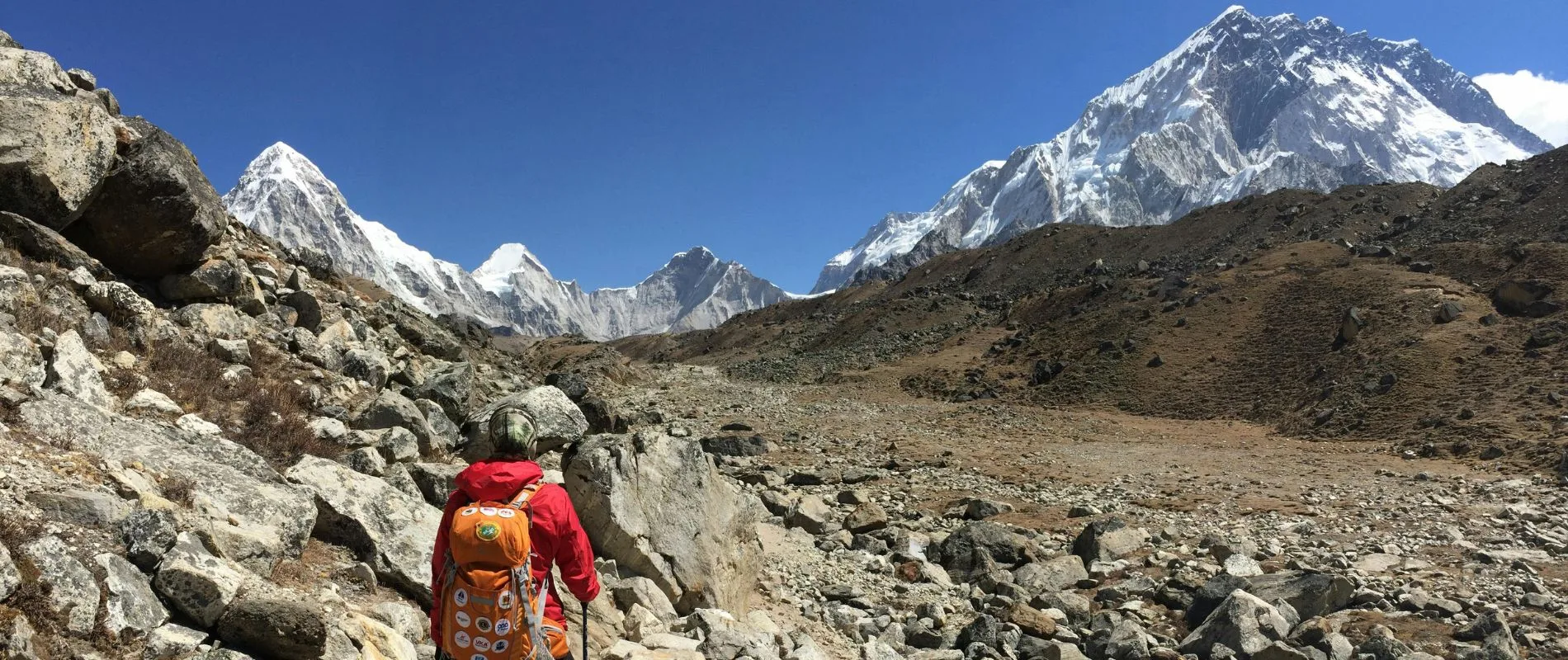
To reach the heart of Khumbu, i.e., Lobuche, which stands at approximately 4940 m (16,208 ft). This trek will take around 5-6 hours. You will pass through the lateral moraine of the Khumbu Glacier and see stone memorials built in remembrance of deceased climbers, enhanced by colorful prayer flags at Thukla Pass. Lobuche offers stunning views of some of the world's highest mountains, including Pumori (7,161 m) and Nuptse (7,861 m). You can then enjoy lunch and walk nearby or rest after reaching the designated lodge.
After 8 days of intense trekking, you finally move towards your final destination, the Everest Base Camp, through Gorakshep village. The trail now gets more challenging due to uneven terrain. Despite the challenges, the captivating views of the Khumbu Glacier and Khumbu Icefalls remain.
After reaching the EBC, you will be mesmerized by the views of Mt.Everest, Mt. Nuptse, Mt. Pumori, and Mt. Khumbutse. You will spend an hour or so capturing memories and enjoying nature before heading back to Gorakshep (5,164m/16,942ft), where you will be staying the night. This brings us to the end of an 8-9 hour-long trek.
On the tenth day, you will hike to the highest point of the EBC trek, where you will get the opportunity to witness the sunrise over the enormous mountains. Kala Patthar (5,644m/18,519ft) is famous for a close-up, unobstructed view of Mount Everest and a 360-degree Himalayan panorama of giant peaks including Lhotse, Nuptse, Pumori, Changtse, and Ama Dablam.
Later, you will descend to Pheriche (4,371m/14,340ft) and stay the night, where you will be served a cozy dinner.
After a peaceful night at Pheriche, you will descend towards Namche Bazaar. As we move towards a lower altitude, it will be easier for you to breathe, and the air will start to warm up. After seven or eight hours of walking, you will finally arrive at the picturesque Namche settlement. Upon reaching Namche Bazaar, you may roam around and buy local handicrafts.
You will leave Namche Bazaar with a light breakfast and head towards Lukla via Phakding and Monjo. Yeti Hikes suggests you walk around the village, as this will be your last day in the Everest region. Before returning to Kathmandu, make the most of every moment and seize all those enduring memories.
This brings us to the end of the EBC trek and marks the start of our journey to the Chitwan Jungle Safari. On the thirteenth day, you will fly from Tenzing Hillary Airport, Lukla, to Kathmandu. For the rest of the day, you will be on your own. You can enjoy this day by shopping for the Chitwan Jungle Safari, roaming around Kathmandu, and enjoying the city life of Nepal.
Your journey to Chitwan will begin with a road trip from Kathmandu. The road takes you through green hills, beautiful landscapes, riverbanks, and traditional villages, giving you a foretaste of Nepal's natural beauty even before reaching the park.
On arrival, you will be welcomed with traditional hospitality. You will also get to explore the Tharu people’s livelihood, their mud-made houses, and learn about their traditional farming practices over lunch. At dinner, you can enjoy an energetic Tharu cultural dance. With that, the first day after arriving in Chitwan comes to an end.
The second day at Chitwan begins with a refreshing breakfast and preparation for a jeep safari into the dense forests. Whilst on the safari, we get to witness Nepal’s endangered animals, including the one-horned rhinoceros, Bengal tiger, wild elephants, and various species of deer and monkeys. You’ll also discover a lost world of towering trees and twisting vines, prehistoric-looking rhinos and lumbering elephants, crocodiles, pythons and deer, and brightly coloured birds.
After the safari, you will go canoeing along the Rapti River to look for mugger crocodiles, the endangered gharial, and waterbirds. Later in the afternoon, you will be taken to visit the elephant breeding center, where you will have time to learn about their care and behavior. You will then be driven back to the lodge, ending the day's wildlife activities with a comforting dinner.
Time moves so fast; we are already at the end of our EBC trek and Chitwan Jungle Safari journey. The last day at Chitwan will begin with peaceful birdwatching. Chitwan National Park is home to over 543 species, including kingfishers in radiant hues, storks, and rare migrating birds. You will also see more of the park's flora and fauna as you walk on the jungle’s trails.
After breakfast at the lodge, we drive back to Kathmandu, which brings your 17-day journey to an end. With that, you take home the best of Nepal’s biodiversity, from the icy glaciers and towering Himalayan peaks to the lush, dense forests and subtropical wilderness of the Terai.
On the last day in Nepal, a country full of biodiversity, we bid our goodbyes. As per your flight schedule, our team will drop you off at the airport, leaving you with memories of your Everest Base Camp trek and Chitwan Jungle Safari. We at YetiHikes wish you a safe journey.
Additional Information Of Everest Base Camp with Chitwan Jungle Safari - 17 days
Flight Information from Kathmandu to Lukla
Lukla Airport is also known as “The Airport of the Mountains” as it is built in the Himalayas. There are two ways to get to the Lukla Airport. During peak season, i.e., March-May and October-November, due to heavy air traffic, Lukla flights are operated only through Manthali Airport. Thus, one may travel through Kathmandu to Manthali via road, which takes approx. 5-6 hours and take a 20-minute flight to Lukla. During the off-season, you could get a direct 30-minute flight from Kathmandu to Lukla.
The flight to Lukla is a small aircraft; one must travel lightly for safety reasons.
Total Baggage Limit: 15 kg (33lbs)
Checked Luggage: 10 kg (22 lbs)
Carry-On: 5 kg(11 lbs)
All baggage limits above are per person. The availability of space may be achieved at the cost of additional expense.
Best Time To Visit Everest Base Camp with Chitwan Jungle Safari
It is crucial to plan the journey for the right season for visibility, safety, and overall comfort throughout the trip. Weather conditions, visibility, and trail accessibility vary throughout the year, making some months far better than others.
Spring Season ( March - May)
Spring is considered the best time to trek to EBC and go on a jungle safari, as it is the dry season with well-defined trails and comparatively stable, predictable weather. There are clear views of the mountain with blooming rhododendron forests along the trails. It is also one of the best seasons for Chitwan Jungle Safari, with clear skies and thinner vegetation making it easier to spot wildlife and birdwatching.
Autumn Season ( September - November)
It is one of the most popular seasons for tourism in Nepal, as autumn offers clear mountain views, comfortable trekking temperatures, and the main festivals, i.e., Dashain and Tihar. It is also an ideal season for jungle safaris, canoe trips, and birdwatching of migratory species.
As it is the most popular season to travel in Nepal, it is overcrowded. It is advisable to make reservations in advance with a licensed trekking company.
Accommodation and Food and Beverage Options during the EBC trek with Chitwan Jungle Safari
All our tour programs include accommodation and food in hotels, lodges, homestays, guesthouses, and resorts. The accommodation may also vary according to travellers' preferences, at an extra cost. Depending on the travellers' pace and health, vehicle availability, unfavourable weather, and trail conditions, the journey might take longer or shorter.
At higher altitudes and in remote areas, where conditions are inaccessible, you might have to adjust accordingly. Some facilities that might be inaccessible include hot showers, laundry, Western-style toilets, internet, and room quality. We may be able to arrange vegan or strict dietary options if we are informed beforehand. It is advisable to carry necessities such as energy bars, sanitizers, toilet paper, and power banks in case they are unavailable.
If non-veg options are available after Namche Bazaar, it is advisable not to consume them, as the meat is transported without refrigeration over several days. This is to prevent severe food poisoning or stomach issues.
Some common food options you find in the teahouses are
Meal Type | Options |
Breakfast | Porridge / Oatmeal, Pancakes, Egg Dishes, Bread and Jam |
Lunch | Noodles, Sandwiches, Rice Dishes, Mo: Mo, Tibetan Bread, Sel Roti, Fresh Fruits, Thukpa |
Dinner | Dal Bhat, Rice and Curry, Potato Items, Tingmo |
Hot beverage | Tea, Coffee, Hot Chocolate |
Cold beverage | Soft Drinks, Bottled Water, Fresh Fruit Juice |
Chitwan, being a comparatively city area, offers a wide range of options for accommodation, food and beverage, and overall facilities.
Availability of Internet, Wi-Fi, Charging Ports
Staying connected throughout the journey requires choosing the right mobile service provider and internet plan. Some available options are:
Local SIM cards: You can easily purchase local SIM cards at airports and shops, but you'll need to present a copy of your passport and a passport-sized photo.
Popular and Roaming Packages: Ncell, NTC, and Airlink SIM provide packages. If you prefer to keep your home SIM, ask your guide for help with international roaming packages. However, roaming charges can be expensive.
Pocket Wi-Fi Rentals: You can rent or buy a portable Wi-Fi device in Kathmandu. This device provides internet access for multiple devices and can be a convenient option for groups.
In Chitwan, except in rural areas, internet, Wi-Fi, and charging ports might be easily accessible. As for the EBC trek, energy infrastructure may be limited in remote areas, and even if it is, load-shedding and energy shortages may occur. It is advisable to carry power banks, cameras, flashlights, and other battery-powered devices.
Need for Guides and Porters
Traveling alongside experienced guides and porters maximises both security and efficiency. They also help bridge the communication gap and handle transportation tasks. Guides maintain comprehensive knowledge of the terrain, emergency procedures, and local weather patterns. The trekking process becomes easier with porters who carry heavy items, allowing walkers to maintain a steady pace. Yeti Hikes sends friendly guides and porters to ensure your safety during the whole EBC Trek and Chitwan National Park journey.
Guides and porters are your true companions who help you reach the destination safely. A tip is recognition and gratitude that can be shown through an action. With a tip, you make a direct difference in the lives of real families and support local communities. Yeti Hikes team highly encourages trekkers to tip their guides and porters well.
We suggest tipping around $15-20 per guide and $10-15 per porter each day, shared across the group, recognising the load they carry. Tipping is completely optional and can vary from person to person. Tipping is a suggestion and is simply a thoughtful gesture of appreciation for the service provided during your travel experience.
Acute Mountain Sickness: Symptoms and Prevention
Acute Mountain Sickness (AMS) is caused by the reduced air pressure and lower oxygen levels at high altitudes. It is one of the primary concerns for trekkers.
The following are common symptoms of AMS.
Headache
Nausea and Vomiting
Dizziness
Confusion
Fatigue
Loss of Appetite
Difficulty in Sleeping
Increased Heart Rate
Swollen Body Parts
Some AMS can lead to life-altering complications like High Altitude Pulmonary Edema (HAPE) and High Altitude Cerebral Edema (HACE).
Some prevention techniques used by our experienced guides are listed below.
Ascend at a steady pace, giving the body time to acclimatize to the rising altitude, and include rest days.
Hydration can gradually reduce the symptoms of AMS. Ideally, one should drink 3-4 liters of water per day.
Anyone with worsening symptoms must not go higher; they should go down and follow the guide's recommendations.
Pay attention to eating carbohydrate-rich foods like rice, fruits, and breads, among others, in small portions to ease digestion and provide energy.
Maintain a sleep routine.
Avoid alcohol, smoking, and tobacco products.
Physical and Mental Fitness for the Everest Base Camp with Chitwan Jungle Safari
The Everest Base Camp trek requires a good level of physical fitness, stamina, and mental endurance. Trekkers should be comfortable walking for approximately 5–7 hours a day on uneven terrain, steep uphill and downhill trails, and at high altitudes reaching 5,364 metres. Regular cardiovascular exercise, hiking, walking, and leg-strengthening exercises before the trip are highly recommended. Previous trekking experience is beneficial but not essential.
Mental preparation is equally important, as the journey involves long trekking days, basic mountain facilities, changing weather conditions, and the challenges of high altitude. Patience, a positive attitude, and the ability to adapt to unexpected situations will make the experience more enjoyable. Following the EBC trek, the Chitwan Jungle Safari is generally less physically demanding, although activities such as jungle walks and canoe rides require a reasonable level of mobility and fitness. Overall, a healthy lifestyle and proper preparation will help you enjoy both the Himalayan adventure and the wildlife experiences of Chitwan.
Some exercises that might be helpful
It is advisable to start specific training 3-4 months in advance. Focus on cardiovascular endurance, leg strength, stamina, and flexibility to prepare for long walking days and steep uphill and downhill trails at high altitude.
Brisk walking, jogging, and cycling to improve cardiovascular endurance.
Hiking on uphill and uneven terrain to build trekking stamina.
Squats, lunges, and step-ups to strengthen leg muscles.
Stair climbing to prepare for steep ascents and descents.
Planks and stretching exercises to improve core strength, balance, and flexibility.
Long walks with a light backpack to build endurance for consecutive trekking days.
Required Documents and Permits for Everest Base Camp Trek with Chitwan Jungle Safari
Passport and Visa
You'll need a valid passport (valid for at least six months) and a Nepal tourist visa. You can obtain the visa on arrival at Tribhuvan International Airport in Kathmandu.
For a 17-day trek with a jungle safari, the 30-day visa is ideal, as it costs around US$50.
Travel Insurance
It is not mandatory, but it is advisable to have a travel insurance policy that covers trekking at high altitudes. For Chitwan Jungle Safari, ensure your policy also covers jungle activities and wildlife excursions, where applicable. Always keep a photocopy of your insurance policy and emergency numbers.
Medical Certificate
A medical certificate is required to confirm the absence of chronic diseases and the ability to undertake strenuous activities.
For the Chitwan Jungle Safari, no additional medical certificate is generally required. However, travellers should be fit enough to take part in activities such as jungle walks, canoe rides and jeep safaris.
Trekkers should be in good general health and free from medical conditions that could pose a risk during the trek. It is advisable to consult a doctor before travelling, especially if you have any pre-existing medical conditions.
Permits for Everest Base Camp Trekking
Considering the Everest Base Camp trek with Chitwan Jungle Safari, you would need multiple permits to enter the premises. Here is the total breakdown of all the licenses you’ll need for this journey.
Permit Type | Purpose | Cost | Note |
Sagarmatha National Park Entry Permit | Required to enter Sagarmatha National Park | USD 22 per person | Mandatory for all trekkers traveling in the Everest region |
Khumbu Pasang Lhamu Rural Municipality Permit | Required to enter the Khumbu Region, including the EBC Trek | USD 15 per person | Replaces the need for a TIMS card for this region |
Chitwan National Park fee | Required to enter Chitwan National Park | Around USD 15 per person | Mandatory for travellers to enter Chitwan National Park |
TIMS Card | Generally required for trekking in Nepal | Not needed | Not required if you have both of the above permits. |
Documents Required to Apply for Permit Application
A clear passport-size scanned copy of the passport with a validity of at least six months.
Passport-sized photos as per requirements.
Trekking Itinerary Details.
Cash (Nepalese Rupees) for permit fees.
Additional documents are required as specified by the permit office or trekking agency.
You should obtain the permits through a registered trekking agency and check with them to ensure all the paperwork is in order before starting your trek.
You can visit the Permits and Documents page for more information.
How to reach Chitwan National Park
Chitwan National Park is easily accessible from Kathmandu. The most common routes include:
By Air: Fly from Kathmandu to Bharatpur Airport, followed by a short drive to the park.
By Road: You can also drive or take a tourist bus from Kathmandu, a journey of around 5-6 hours.
Activities in Chitwan National Park
Jungle Safari: Explore dense forests and open grasslands and witness Nepal’s wildlife, including endangered species.
Canoe River: Enjoy a peaceful canoe ride on the Rapti River and spot crocodiles, gharials, and various waterbirds along the banks.
Tharu Cultural Experience: Discover the rich traditions and lifestyle of the indigenous Tharu community through a village visit, traditional mud houses, and an evening cultural performance featuring vibrant Tharu dance and music.
Bird Watching: Chitwan National Park is a haven for bird watchers, home to more than 543 bird species.
Extra Expenses In The Trip
It is better to carry some extra cash (NPR) to cover the cost of the trip and purchase essential snacks, beverages, and souvenirs along the journey. There are no hidden costs with Yeti Hikes; the extra cost depends solely on the trekker’s choice and preferences.
FAQs Of Everest Base Camp with Chitwan Jungle Safari - 17 days
Recommended Blogs
Lukla: Gateway to Everest Region
The small and active town of Lukla, also known as the Gateway to Everest Region, rests at 2,860 meters elevation. It is the initial stop with an exciting airport runway, appealing scenery, and friendly Sherpa people. Lukla settlement sits within the Himalayas; therefore, it is most Everest Base Camp trekkers' initial stop or basecamp gateway. Lukla town gives trekkers the experience of where the real expedition kicks off. The Lukla Airport Experience: A Heart-Pounding Landing Lukla Airport, Tenzing Hillary Airport, has a 527-meter runway shaped into the mountains that finish with a drastic slope toward the valley underneath. It is one of the most thrilling and globe's most perilous runways. Every flight at the Lukla Airport is spectacular, where sudden changes with powerful winds will hit you, and the visibility remains unpredictable. The demanding atmosphere conditions are why we call it one of the most dangerous airports in the world. However, you don't need to worry much as the pilots possess advanced flying skills that deliver memorable flight experiences. Upon stepping to the airport, you'll enter a world of mountain freshness surrounded by Everest Region, the beauty at first sight. Lukla Flight Baggage: Packing Smart for the Journey Due to high-altitude conditions together with short runway dimensions at Lukla Airport airlines enforce strict weight limits for passenger luggage. Every air traveler gets permission to bring 15 kg of baggage, consisting of 10 kg for check-in and 5 kg for hand-carry. Additional baggage transportation is possible at an extra cost, but it depends on the aircraft weight capacity. Travelers must organize their items thoughtfully for trekking because pack size and weight limits should always be considered. Alternative Travel Option to get to Lukla Travel Via Jiri Those who want to escape the Lukla flight along with enjoying the rural landscapes of Nepal should consider this route. If you start from Jiri, it will take 3-4 days to walk to Lukla while letting you encounter isolated communities as well as extraordinary mountain panoramas and genuine Nepali traditions. The overland path provides visitors with rare connectivity along its less busy path before travelers start their Everest journey from Lukla. Trek to Lukla People interested in an active start can begin their trek from Salleri a town which you can access by bus from Kathmandu. Traveling from Salleri to Lukla via this route requires two to three days of walking, thus giving slower-paced adventure seekers excellent options to acclimate while admiring regional natural scenery. Your trek to Lukla entails admiring forests and river views besides exploring charming local villages. You can use this trail if you want to experience the cultural and environmental exposure. Gateway to Adventure: Setting Foot on the Everest Trail Trekkers start their legendary Everest Base Camp trek from Lukla town. People start their trip by descending to Phakding before steadily climbing through forested areas with rhododendrons, crossing bridges along the way to visit Sherpa settlements. Nature combines seamlessly with cultural excellence along this journey, establishing conditions for what will become both challenging and fulfilling for future tourists. Several exceptional trekking packages, in addition to the Everest Base Camp trek, exist throughout this region. The Gokyo Valley Trek and the Pikey Peak Trek are popular choices in the area, and they showcase different views of the Himalayas. Mountaineers can select the Island Peak Climbing expedition or the Everest Three Pass Trek as opportunities to climb through exhilarating mountain terrain. The Khumbu Everest Region: A Land of Majestic Peaks With its towering peaks, such as Mount Everest (8,848.86m), Lhotse (8,516m), and Ama Dablam (6,812m), the town of Lukla is the main entry point to the Khumbu Everest Region. Among its qualities are the Sherpa's rich cultural heritage, natural scenery, and well-known trekking routes. Visitors walking through the Khumbu area encounter Namche Bazaar Tengboche Monastery, and Kala Patthar, where they can see the Everest summit without obstruction. Travelers who take each trail through Khumbu become a part of a wonderland that combines divine landscapes with natural splendor. The Charm of Lukla: A Town Full of Life and Flavor Lukla serves beyond its primary function as a base for trekking activities because the town itself provides various attractions. Numerous cozy tea houses, busy shops, and bakery concessions serving culinary delights warmly welcome weary travelers to this town. Visitors who want to experience Sherpa hospitality must visit this destination because the resilient people of Sherpa are known worldwide for their friendly spirit. Before moving deeper into the Khumbu region, many visitors choose to spend their night catching the active scenes that Lukla provides. Accommodations in Lukla: Resting Before the journey Basic yet cosy lodges are available for visitors to Lukla. In order to help trekkers rest before starting their journey, lodge accommodations offer them hot meals, internet access, and sleeping blankets. Among the many lodging options along Lukla, guesthouses offer visitors breathtaking views of the mountains.Trekkers are given basic but comfortable lodging, Tibetan bread, Sherpa stew and hot tea to help their bodies acclimatise to the altitude changes. Cultural Experiences and Festivals in Lukla People visiting Lukla can witness Buddhist traditions through their exploration of local monasteries while observing routine religious practices. Mani Rimdu Festival stands as the main religious festival of the area where Tengboche Monastery hosts ceremonies with masked dances to observe the victory of Buddhism over evil entities. Festival visitors who visit at this time become fortunate observers of Sherpa traditions which have remained unchanged for many generations. Acclimatization in Lukla Visitors need to prepare for Lukla's high altitude of 2,860 meters because spending one night in this elevation allows them to start adapting to the elevation change. The prevention of altitude sickness depends on staying hydrated while eating well with no alcohol consumption. Trekking success at high altitudes demands that new climbers start their experience at a gradual pace. The process of adapting to thinner air requires trekkers to implement a strategy called "climb high, sleep low." Exploring the Lukla: Short Hikes Before the Trek Lukla to Chheplung Village You can walk from Lukla to Chheplung within 1-2 hours thus reaching this small village near Lukla. The path covers verdant regions as it reveals breathtaking landscapes that surround mountains and valleys. The peaceful environment offers a great opportunity to adapt to high-altitude levels in a beautiful setting. Chheplung offers tranquility to travelers who stop here to rest before their Everest Base Camp expedition. The easy hike enables newcomers to discover the splendor of the local area. Lukla to Tenzing Hillary Memorial Mount Everest fans should consider exploring from Lukla to Tenzing-Hillary Memorial during a short 1-2 hour trek toward the memorial site that honors Sir Edmund Hillary and Tenzing Norgay for their first person summit. The route combines natural beauty and educational stops because it shows visitors parts of the mountains while presenting information about Tenzing Norgay and Edmund Hillary. The Tenzing-Hillary Memorial serves as both a historical site and memorial to the Everest summit pioneers, so it attracts those with historical interest and admiring fans of the climbers who became legends on the mountain peak. Lukla to Sano (Little) Everest A strenuous trail for those seeking adventure from Lukla leads to Sano Everest, known as Little Everest. Travelers need 2-3 hours to complete this hike which provides stunning perspectives of Mount Everest and Lhotse. Although demanding at times, the Himalayan vista you encounter during this trek makes it a distinctive short hiking experience. The trail functions as an introductory trek which provides hikers to see beforehand the dramatic mountain views that appear on Everest Base Camp routes. Before beginning your primary trekking journey you can use these nearby hikes in Lukla to adjust to altitude while exploring nearby natural beauty. These short local walks serve as excellent beginnings for your Himalayan adventure since they give you a feel for the natural beauty and cultural richness of the Everest region. The town of Lukla gives travelers multiple ways to begin their expedition including visiting peaceful places and discovering Everest historical sites while enjoying views of the mountains. Choose the Right Season The best season to trek to the Everest Region in Nepal is in Spring (March - May) and Autumn (September to November). These seasons have mild temperatures and clear skies that help in easier navigation during the trek. While the winter season brings heavy snowfall as a harsh condition, the monsoon season from June to August brings unpredictable weather patterns that often cause flight delays. If you plan ahead, your trip to Everest will go smoothly. Conclusion: Where Every Everest Journey Begins Lukla functions beyond its airport role as the gateway of Everest, although it delivers a distinct experience to its visitors. The town of Lukla creates lasting travel memories for everyone because of its airport thrills and its Himalayan mountain panorama. People who love adventures or nature will find this delightful mountain town as their first stop on their journey to reach Earth's tallest peak. The Khumbu Everest Region will become a lifetime memory, along with expert guidance from Yeti Hikes.
Everest Dudhkoshi Cultural Trail
The Everest Dudhkoshi Cultural Trail at Lower Solukhumbu Nepal was officially launched on September 01, 2025. The new trail has been recently developed by Mapya Dudhkoshi Rural Municipality (RM) and Trekking Agencies’ Association of Nepal (TAAN). With further help from NTB/UNDP Sustainable Tourism for Livelihood Recovery Project (STLRP), the freshly explored trekking destination serves as a gateway to Everest Base Camp and Mera Peak Trek. If you are dreaming about Mount Everest, this new trekking route is applicable even without even going to high altitude! The highest point of the trek is just 3,168m high therefore, it is accessible to all trekkers. With different duration and activities, the Everest Dudhkoshi Cultural Trail offers 05 different itineraries. Mapya Dudhkoshi Trekking Itinerary 01: Days Program 01 Drive from Kathmandu to Salleri 02 Trek to Kudham Mid Camp via Ghumne Mera 03 Morning Kudam View Point and Trek to Yotelmya 04 Trek to Khastap via Rappchha 05 Drive to Salleri via Bhumesthan Paasdha (Sundar Jharana) and Mahabhir 06 Drive back to Kathmandu Mapya Dudhkoshi Trekking Itinerary 02: Days Program 01 Drive from Kathmandu to Salleri 02 Trek to Ghumne Mera via Ratnangge 03 Morning Kudam View Point and Trek to Yotelmya 04 Trek to Juving via Andheri 05 Trek to Deurali via Hill, Solaban and Jaleswori Mandir 06 Trek to Waku and Drive to Iosku via Kanku Bhumesthan 07 Drive to Salleri via Paasdha Jharana, Mahabir Rock Climbing Sport 08 Drive back to Kathmandu Mapya Dudhkoshi Trekking Itinerary 03: Days Program 01 Drive from Kathmandu to Salleri 02 Trek to Ghumne Mera via Ratnangge 03 Morning Kudam View Point and Trek to Yotelmya 04 Trek to Juving/ Bumburi 05 Trek to Solaban via Jube, Hill 06 Trek to Waku via Deurali 07 Drive to Salleri via Paasdha Jharana, Mahabir Rock Climbing Sport 08 Drive back to Kathmandu Mera Peak Itinerary via Waku, Mapya Dudhkoshi (Itinerary 04) Days Program 01 Drive to Waku via Kaya Khet 02 Trek to Solaban via Deurali/ Jaleswori Mandir 03 Trek to Sibuje 04 Trek to Chhatra Khola 05 Trek to Kothe 06 Trek to Thangnak 07 Drive to Khare 08 Acclimatization Day at Khare 09 Trek to High Camp 10 Trek to Mera Peak and back to Khare 11 Trek to Taktho 12 Trek to Ramailo Dada 13 Trek to Sibuje and Drive to Salleri 14 Drive back to Kathmandu Mera Peak Itinerary via Salleri, Mapya Dudhkoshi (Itinerary 04) Days Program 01 Drive to Salleri 02 Drive to Jube 03 Trek to Sibuje 04 Trek to Chhatra Khola 05 Trek to Kothe 06 Trek to Thangnak 07 Drive to Khare 08 Acclimatization Day at Khare 09 Trek to High Camp 10 Trek to Mera Peak and back to Khare 11 Trek to Taktho 12 Trek to Ramailo Dada 13 Trek to Sibuje and Drive to Salleri 14 Drive back to Kathmandu Everest Base Camp Trek via Mapya Dudhkoshi (Itinerary 05) Days Program 01 Drive to Salleri 02 Trek to Kudham via Ghumne Mera 03 Trek to Kharikhola 04 Trek to Surke 05 Trek to Monjo 06 Trek to Namche Bazaar 07 Acclimatization Day at Namche Bazaar 08 Trek to Phortse 09 Trek to Dingboche 10 Trek to Lobuche 11 Trek to Gorakshep and explore Everest Base Camp 12 Early morning Kalapatthar and back to Pheriche 13 Trek to Tengboche 14 Trek to Monjo 15 Trek to Lukla 16 Flight back to Kathmandu Journey from Kathmandu to Salleri By Road (Bus or Jeep) Mode Route Distance Time Duration Cost (USD) Bus Kathmandu → Dhulikhel → Khurkot → Ghurmi → Salleri 267 km 10 - 13 hours $15 to 30 Shared Jeep Kathmandu → Chabahil → Dhulikhel → Khurkot → Ghurmi → Salleri 267 km 8 - 10 hours $25 to 50 Private Jeep Kathmandu → Chabahil → Dhulikhel → Khurkot → Ghurmi → Salleri 267 km 8 - 10 hours $250 to 450 By Air (Flight to Phaplu and Drive to Salleri) Mode Route Distance Time Duration Cost (USD) Flight + Drive Kathmandu → Phaplu (flight) Phaplu → Salleri (drive) 267 km 3 hours $110 to 430 Nature and Wilderness along the Everest Dudhkoshi Cultural Trail The Everest Dudhkoshi Cultural Trail is a beautiful journey full of natural scenery, surrounded by gurgling streams, from lush green forests to terraced farmlands and sparkling rivers. The trail passes through an amazing patch of rhododendron forests along with mountain The Dudhkoshi River winds through deep valleys and the traditional farming terraces that cascade down the hillsides. The dense oak, birch, and conifer forests in lower and mid altitude sections adds a pristine beauty at every turn. The trail offers spectacular views of the Himalayan Peaks like Mount Everest (8,848m), Ama Dablam (6,812m), Thamserku (6,623m), Kangtega (6,782m) and Lhotse (8,516m). Along the way, you will find various: Flora: Rhododendron, Bamboo, Oak, Pine, Fir, Birch, Juniper, Alpine shrubs, Hardy grasses and wildflowers like primula and gentians. Fauna: Himalayan Tahr, Musk Deer, Red Panda, Langur Monkeys, Blood Pheasant, Snow Partridge, Woodpeckers and rarely Snow Leopard. Cultural and Spiritual Beliefs along the Everest Dudhkoshi Cultural Trail Mapya Dudhkoshi is deeply influenced by the Sherpa community and Khaling Rai, Tamang, Magar, Chettri as well as Brahmin communities. By staying in local homestays, you can truly experience their own cultural dances, folk songs and ancestral rituals and traditions. Festivals throughout the year: Waas Festival (Khaling Rai festival) Ubhauli and Udhauli (Kirat Rai festival Lhosar (Sherpa and Tamang New Year) Dashain and Tihar (Nepal’s largest Hindu festival) Along the trail you will see many monasteries, stupas and gompas as the centers of prayer and meditation. You will often find prayer wheels and prayer flags that hold spiritual significance. Best Season to Trek Everest Dudhkoshi Cultural As per the Mapya Dudhkoshi Rural Municipality, Solukhumbu, the Everest Dudhkoshi Cultural Trail is an all season trek hence, you can trek throughout the year. The spring (March to May) and autumn (September to November) offers the clearest skies and breathtaking mountain views of Mt.Everest, Number, Lhotse, Baruntse, Thamserku, and many more. The trail is still accessible during the monsoon (June to August) and winter (December to February) and has serene snow-clad landscapes. From peaceful snowy landscapes to blooming rhododendrons, every season has its own charm! Adventure activities on the Everest Dudhkoshi Cultural Trail Rock Climbing Rock climbing is possible on some of the trail's rocky cliffs and rocky terrain. Climbs on natural rock faces are occasionally organised by local guides, providing adventurers with an exhilarating opportunity to test their stamina and skill while taking in the breathtaking Himalayan landscape. Cycling Mountain biking and cycling adventures are possible in the lower parts of the Dudhkoshi region. As you pass through Sherpa villages, you can experience both physical challenge and cultural immersion as you navigate through rolling hills, suspension bridges, and forest trails. Honey Hunting Locals use ropes and ladders to scale steep cliffs in order to collect wild honeycombs created by enormous Himalayan bees, making honey hunting a distinctive traditional adventure. You can watch or even take part in this risk-taking activity that combines adrenaline and cultural tradition. Everest View Trail Marathon Parts of the Dudhkoshi and Khumbu trails are traversed by the Tenzing–Hillary Everest Marathon, one of the highest-altitude races in the world, which is geared towards extreme adventurers. With breathtaking views of Everest and the surrounding peaks, you will traverse rocky mountain trails, suspension bridges, and steep ascents. Accommodation during the Everest Dudhkoshi Cultural Trail Traditional homestays are the primary form of accommodation during the Everest Dudhkoshi Cultural Trail, providing you with a cosy and genuine experience. Typically, rooms are modest but cosy, with simple bedding and communal amenities. In addition to boosting the local economy, this kind of lodging enhances the trip by fusing adventure with cultural awareness and real-life community engagement. Homestays offer a distinctive way to experience Sherpa culture in addition to comfort. You can assist in cooking, discover regional traditions, hear folktales, and even take part in small celebrations or village events. Required documents and permits for the Everest Dudhkoshi Cultural Trail The required permits for the Everest Dudhkoshi Cultural Trail are Sagarmatha National Park Entry Permit and Khumbu Pasang Lhamu Rural Municipality Permit. Permit Cost (USD) Sagarmatha National Park Entry Permit 25 USD Khumbu Pasang Lhamu Rural Municipality Permit 15 USD The required documents for the Everest Dudhkoshi Cultural Trail are Valid Passport Nepal Visa Passport Sized Photographs Travel Insurance Trekking essentials and facilities Along the Everest Dudhkoshi Cultural Trail, mobile phones and other devices networks are limited. Basic data services and inexpensive calling are offered by local SIM cards such as NCELL or NTC. Since electricity can be limited in isolated villages, you need to carry power banks, solar chargers, headlamps, and cameras to make the trek more convenient. Many teahouses, homestays, and lodges offer Wi-Fi and internet, frequently for a nominal fee . Conclusion: Scenic and Accessible Trekking on the Dudhkoshi Trail If you are looking for a combination of adventure, cultural immersion, and scenic beauty without the difficulties of high-altitude trekking, the Everest Dudhkoshi Cultural Trail is the perfect option. Since the trail only reaches a maximum elevation of 3,168 meters, it is relatively easy and appropriate for hikers of all ages, including novices and families. Choosing this trek offers a fulfilling adventure that strikes a balance between comfort, culture, and scenery. The Everest Dudhkoshi Cultural Trail is a safe and easy experience of Sherpa culture, beautiful landscapes, and Himalayan views!
Everest Base Camp Trek Itinerary and Map Breakdown
Table of Contents Explaining the Trekking Route of Everest Base Camp Trek Itinerary breakdown of Everest Base Camp Trek 14 Days Day 1: Arrival in Kathmandu and transfer to hotel Day 2: Flight from Kathmandu to Lukla and Trek to Phakding Day 3: Trek to Namche Bazaar Day 4: Acclimatization in Namche Bazaar Day 5: Trek to Tengboche Day 6: Trek to Dingboche Day 7: Acclimatization Day at Dingboche Day 8: Trek to Lobuche Day 9: Trek to Everest Base Camp through Gorak Shep Day 10: Trek to Kala Patthar and descend to Pheriche Day 11: Trek back to Namche Bazaar Day 12: Trek back to Lukla Day 13: Flight back to Kathmandu Day 14: International Departure 12-Day EBC Trek or 14-Day EBC Trek: Which one to Choose? The Everest Base Camp Trek gives travelers a remarkable adventure that includes mountain adventures up to Himalayan summit heights. Climbing the mountain lets people feel Himalayan winds while exchanging greetings with Sherpas to gain significant knowledge about the Everest journey. The entire route of Everest Base Camp reveals essential elevation statistics while providing astonishing views of the surrounding territory. The journey commences its path at Lukla airstrip base then progresses to Sherpa settlements before entering rhododendron forests and eventually reaching mountain valleys before reaching the vicinity of Mt. Everest. The map designates Namche Bazaar as an essential place to visit after Tengboche Monastery and it shows Base Camp's maximum elevation point. Foreseeing the upcoming path and obtaining trekking route knowledge enables you to plan ahead for your trip to Everest Base Camp. Explaining the Trekking Route of Everest Base Camp Trek At Tribhuvan International Airport (TIA) Yeti Hikes staff take responsibility to welcome you before driving to your reserved hotel. A first part of the trekking preparation session focuses on safety practices and equipment information followed by market sightseeing before having dinner. The trek begins with a 30-minute spectacular journey by flight, which brings visitors to Lukla, where they enter the territory of Everest Base Camp. You will travel downhill to Phakding while climbing up to Monjo before reaching Namche Bazaar which becomes the central hub of the Khumbu region. The trail extends through forests of rhododendron trees as well as Sherpa residential districts and suspension bridges before arriving at the monastery of Tengboche after visiting Namche Bazaar. The trek leads hikers from Pangboche to allow them to reach Dingboche and enhance their fitness level before attempting Nangkartsang Peak. Viewing memorials along Thukla Pass stands between Lobuche and Gorak Shep until reaching the destination of Everest Base Camp. Visitors need to witness Khumbu Glacier to enjoy the completion of their demanding hike because the glacier has multiple peaks alongside it. From the following day, you can begin the trek up to Kala Patthar, the highest point, with excellent Everest viewpoints, until you reach Pheriche. After Namche Bazaar, the tour follows backward towards Lukla until the excursion is concluded. The return flight will take you to Kathmandu, where you can see the active city life before joining the farewell dinner celebrations. The Yeti Hikes team will you to the airport on the last day of this exceptional Everest Base Camp trek. We wish you safe travels as you take away enduring memories of the Himalayas and the remarkable adventure you've gone through. Bon Voyage! Itinerary breakdown of Everest Base Camp Trek 14 Days Day 1: Arrival in Kathmandu and transfer to hotel Your trip will begin as soon as you land at Kathmandu's Tribhuvan International Airport (TIA), where our Yeti Hikes personnel will greet you. We will take you to the assigned hotel in the area and you a warm welcome. Day 2: Flight from Kathmandu to Lukla and Trek to Phakding Lukla Airport, or the Tenzing Hillary Airport, is known as one of the most dangerous airports in the world because of its unusual location and comparatively short runway. The exceptional airport faces a short distance, but unexpected high winds and changing visibility can affect the flight time. Since 1979, Phakding has been a UNESCO World Heritage Site. North of Lukla and South of Monjo have often been the resting point for trekkers on their way to Mt. Everest Peak Climbing. Once in a while, the famous stopping point, the Phakding Village, accommodates a maximum of 300 trekkers or tourists like you. Trek info: Flight Duration: 30-40 minutes on clear days.Trek Duration: 3-4 hours, a relatively easy walk.Trail Conditions: Easy to moderate, rocky, and sometimes gradually uphill. Day 3: Trek to Namche Bazaar AKA: Namche Bazaar/ Nemche Bazaar/ Namche Baza Located in Khumbu Pasanglhamu Rural Municipality in Solukhumbhu District, the place is the main trading center and hub. The village has the Syangboche Airport, which is no longer used for passenger flights and is only occasionally available for Russian cargo flights. The cultural mix along the Silk Road inspired a song, namely "Namche Bazaar" by Nathan Rogers on his album The Gaunlet. Trek info: Trek Duration: 5-6 hours(Phakding to Namche Bazaar).Trail Conditions: Moderate, some altitude gains, uphill sections. Day 4: Acclimatization in Namche Bazaar The rest day in Namche Bazaar allows you to visit the existing German bakeries, little cades, and many restaurants. You can try the popular local meal, the yak steak, and check out the Irish Pub. Day 5: Trek to Tengboche AKA: Tengboche/ Thyanboche Tengboche Monastery, an important Buddhist monastery, was built in 1923 in the Tengboche village. Tenzing Norgay, popularly known as the first man to reach the summit of Mount Everest, was once sent to the monastery to be a monk. Trek Info: Trek Duration: 5-6 hours(Namche Bazaar to Tengboche).Trail Conditions: Moderate with some steep sections and a bit rocky. Day 6: Trek to Dingboche Due to its relatively mild climate, Dingboche is also called the "Summer Valley". Despite the harsh altitude, it is home to the highest potato farm in Nepal. It is also one of the gateways to Everest Base Camp and a popular resting stop for trekkers. Trek info: Trek Duration: 4-5 hours(Tengboche to Dingboche).Trail Conditions: Moderate with gradual uphill stretches, rocky and dusty paths. Day 7: Acclimatization Day at Dingboche Nangkartsang Peak is a hiking area in Khumjung, an easy ascent that will take 2 or 3 hours to reach the best view of the Ama Dablam, Makalu, Cho Oyu, etc. It is one of the hiking areas to hike and spend the acclimatization day at Dingboche. Day 8: Trek to Lobuche Lobuche, also spelt as Lobuje has two main peaks: Lobuche East (trekking peak) and Lobuche West (Lobuche West). The east peak is climbed more frequently as it's easier, and the first recorded ascent was by Laurence Nielson and Sherpa Ang Gyalzen on April 25, 1984. Trek info: Trek Duration: 7-8 hours(Dingboche to Lobuche).Trail Conditions: Moderate, steady ascent with rocky and gravel paths. Day 9: Trek to Everest Base Camp through Gorak Shep The Everest Base Camp is the rudimentary campsite at the base of Mt. Everest. There are two base camps: South Base Camp, which is used when climbing via the southeast ridge, and the North Base Camp, used when climbing via the northeast ridge. Gorak Shep translates to "the vultures' lake" because the area used to be the habitat for vultures. However, it is now a popular resting point before the final leg to the Everest Base Camp trek. The village was once a lake, but it has dried up, leaving behind a desolate, rocky plain area. Trek info: Trek Duration: 3-4 hours(Gorak Shep to Everest Base Camp).Trail Conditions: Moderate, challenging due to the high altitude, steep, and rocky terrain. Day 10: Trek to Kala Patthar and descend to Pheriche "Black Rock," or Kala Patthar, is the ideal place to get close-up views of Mount Everest without actually climbing it. Everest Base Camp does not offer a full panoramic view of the peak, but Kala Patthar does! Because Pheriche is a prominent yak-grazing area, yaks are frequently seen here! Trekkers and climbers can learn about altitude sickness at the high-altitude research centre in the picturesque village of Pheriche. Trek info: Trek Duration: 7-8 hours (Kala Patthar ascent and descent to Pheriche).Trail Conditions: Steep ascent to Kala Patthar, followed by a long, rocky descent. Day 11: Trek back to Namche Bazaar As we approach Namche Bazaar, the lively atmosphere of this Sherpa town is a welcome change after days in the remote highlands. Trek info: Trek Duration: 6-7 hours (Pheriche to Namche Bazaar)Trail Conditions: Moderate, mostly downhill, but some short uphill climbs can be tiring. Day 12: Trek back to Lukla One of the trek's longest and highest bridges, the Hillary Suspension Bridge, sways significantly over the Dudh Koshi River, making for an exhilarating trip! The trekking trip concludes when you reach Lukla, where you may celebrate before your flight back. Trek info: Trek Duration: 6-7 hours (Namche Bazaar to Lukla)Trail Conditions: Moderate, long descent with uphill sections, rocky trails, and forested paths. Day 13: Flight back to Kathmandu The return trip to Kathmandu is here. You’ll have a short flight back to Kathmandu reminiscing the beautiful arial views of the peaks and cities. The bright blue sky is some heavenly feeling! Day 14: International Departure We say our goodbyes on our last day in Nepal, a wonderful country surrounded by stunning mountains and the Himalayas. Our employees will drop you off at the airport in accordance with your planned flight. We at Yeti Hikes hope you all have a wonderful journey! 12-Day EBC Trek or 14-Day EBC Trek: Which one to Choose? Both the 12-Day and 14-Day EBC Trek follows a similar route with a slight difference in the acclimatization days and the pace of the journey. Key Differences: 12-Day EBC Trek 14-Day EBC Trek Acclimatization Days 1 Day at Namche Bazaar 1 Day in Namche Bazaar1 Day in Dinbgboce Pace of the trek Daily longer hikes, covering more distance. Moves at a more gradual pace. Return Journey Combines Kala Patthar hike and descent to Namche in one day. Splits the descent into two days, with a stop at Pheriche. Which one to choose? Best for experiences trekkers with good fitness. Ideal for a safer and more comfortable pace.