Annapurna Base Camp Trek -14 Days
 in TripAdvisor
Recommended by 99% of travelers
AI Overview & Key Expedition Facts
Curated by Yeti Hikes Sherpa Intelligence
Overview Of Annapurna Base Camp Trek -14 Days
- Region
- Annapurna Region
- Destination
- Nepal
- Max Altitude
- 4,130 m/13,549 ft
- Activity
- Trekking in Nepal
- Duration
- 14 days
- Group Size
- 1-20
- Best Season
- Late Sep-Nov and Feb-May
- Accommodation
- Tea House/ Lodge
- Meals
- Breakfast+Lunch+Dinner
- Transportation
- Private/Shared Vehicle
Highlights Of Annapurna Base Camp Trek -14 Days
Scenic drive between the capital city Kathmandu and beautiful Pokhara
See wonderful waterfalls and glaciers
See Fish tailed Shape Mountain: Macchapuchre aptly named fishtail
360 panoramic views at Annapurna base camp
View of world highest mountains Dhaulagiri I (7th) and Annapurna I (10th)
Natural Hot spring bath at Jhinu Danda.
Description Of Annapurna Base Camp Trek -14 Days
The Annapurna Base Camp Trek is one of the most famous trekking destinations in the world because of the excellent prospects of viewing the Annapurna massif. This trek provides chances to reach into the heart of the Annapurna Sanctuary, the high glacial basin surrounded by some of the highest mountains in the world: Annapurna I (8,091m), Annapurna South, Hiunchuli, and Machapuchare-Fishtail Mountain.
The trails to Annapurna Base Camp, often known as the Annapurna Sanctuary Trek, make their way upward through forests and across rushing rivers to stunning trials. This is a trekking tour itinerary through Nepal that leads into the well-recognized Annapurna Base Camp.
Why trek to Annapurna Base Camp? How hard is it?
If you are ready to be a part of us on this once-in-a-lifetime journey to Annapurna Base Camp Trekking, do not hesitate to contact us at any time. Our tour representatives are always there to solve your problems relating to queries about your tour. We are also open for customization on your tour according to your preference. We are open to flexibility.
Continuing, the Annapurna base camp trekking package offers the catching eye and overwhelming views of some of the highest peaks in the world: Machapuchare, also very well known as Fishtail Mountain, Annapurna South, Hiunchuli, and the Annapurna I (8,091 m). The topography is varied: glaciers, high alpine meadows, and rich forests.
The trek to Annapurna Base Camp is rated as moderate; therefore, it's easily accessible to trekkers of any experience level. This trek is suitable for both avid trekkers and physically fit beginners because it does not require technical skills in climbing.
Because the Annapurna Base Camp trek is rated as a moderate trek, trekkers of all experience levels can complete it. It doesn't require technical climbing skills; hence, both fit beginners and seasoned trekkers can take part in it.
How do the treks to Annapurna Base Camp start and end?
Starting from Pokhara, a well-renowned tourist destination in the country, highly extolled for its beautiful lakes and breathtaking view of mountains, the Annapurna Base Camp Trek passes past mid-hill settlements of Ulleri and Tikhedhunga into the picturesque village of Ghorepani, winding through the cultural heartlands of the Gurung and Magar-Poon groups.
The climb up Poon Hill is one of the most memorable days on the trek, which reportedly has one of the best sunrises in Nepal. It was just brilliant, and I don't even think words would do justice to describe this feeling of watching mountains change color into a shade of gold in the first rays of sunrise.
Having seen our magnificent sunrise, we walked back for breakfast at Ghorepani and then continued on our way towards Tadapani. Amazingly, on this travel, we were astonished by the magnificent Machhapuchhre, also called Fish Tail Mountain. From Tadapani, after our journey, we reached Chomrong, which is is considered a home of brave warriors. Later on, the path led us through Dovan, Bamboo, and finally Machhapuchhre Base Camp, which was a vital stop to Annapurna Base Camp. After we took in the stunning view at ABC, we walked down to Bamboo and made a side trip to Jinu Danda, which is famous for its therapeutic hot springs in Jhinu village. Finally, after that, we concluded our spectacular walk over Ghorepani Poon Hill, Machhapuchhre Base Camp, and Annapurna Base Camp by heading back to Pokhara.
Best Season for Annapurna Base Camp trekking?
When it comes to going for Annapurna Base Camp hiking, the best time for you is a matter of personal preference. If you want nice weather and don't mind crowds, then spring is the best time of the year to visit. Otherwise, if you will not like being in the middle of crowds and do not mind the chilliness of the weather, then autumn would be a great alternative.
Spring (March, April, May: The traditional trekking season in the Himalayas. Usually, there are clear, sunny days together with cold nights. Due to the clear skies, beautiful views of the Alps are available. Furthermore, you will be presented with a breathtaking view of rhododendrons in full bloom, coloring the mountainsides brilliantly.
Autumn: The treks in the Annapurna region are also great during September, October, and November. The weather is stable; skies are clear, and temperatures are comfortable. You'll have more of the route to yourself because there aren't as many people as there are in the spring.
Season | Pros | Cons |
Spring | Clear skies, warm days, cool nights, rhododendrons in bloom | Crowded trails, unpredictable weather at the beginning and end of the season |
Autumn | Stable weather, clear skies, pleasant temperatures, fewer crowds | Colder temperatures than spring |
Annapurna Base Camp Trek (ABC) Distance and Altitude Coverage
Here’s a table outlining the distance, time taken, and elevation gain/drop for each day of a 14-day Annapurna Base Camp (ABC) trek itinerary:
Day | From | To | Distance (km) | Time (hrs) | Elevation Gain (m) | Elevation Drop (m) |
|---|---|---|---|---|---|---|
1 | Kathmandu | Pokhara (Drive/Flight) | - | 6-7 (Drive) | - | - |
2 | Pokhara | Nayapul - Tikhedhunga | 9 | 4-5 | 500 | 0 |
3 | Tikhedhunga | Ghorepani | 12 | 6-7 | 1,200 | 50 |
4 | Ghorepani | Poon Hill - Tadapani | 11 | 6-7 | 600 | 1,100 |
5 | Tadapani | Chhomrong | 10 | 5-6 | 400 | 700 |
6 | Chhomrong | Bamboo | 8 | 4-5 | 400 | 200 |
7 | Bamboo | Deurali | 9 | 5-6 | 800 | 0 |
8 | Deurali | Annapurna Base Camp (ABC) | 7 | 5-6 | 900 | 0 |
9 | ABC | Bamboo | 16 | 6-7 | 0 | 1,700 |
10 | Bamboo | Jhinu Danda | 10 | 5-6 | 200 | 1,100 |
11 | Jhinu Danda | Landruk | 6 | 3-4 | 400 | 500 |
12 | Landruk | Nayapul - Pokhara | 10 | 5-6 | 200 | 700 |
13 | Pokhara | Kathmandu (Drive/Flight) | - | 6-7 (Drive) | - | - |
Notes:
Day 4 includes a morning hike to Poon Hill for sunrise views, followed by a trek to Tadapani.
Day 9 involves descending from ABC to Bamboo, making it a longer descent day.
Total Distance (approximately): ~108 km
Preparation, physical fitness, and mental stability
The physical fitness for the trekking of Annapurna Base Camp is very essential. Running, cycling, and swimming start on time in order to increase heart and lung capacity. Squats, lunges, and push-ups strengthen the lower and upper body. It is very important to perform flexibility and balancing exercises such as yoga and stretching, which prevent injuries and enhance performance generally when trekking. Regular trekking on varied trails will give a complete simulation to the trekking conditions and prepare your body for it.
Mental Streng is the unsung hero of trekking, helping a trekker play a very vital role in the success of a trek. Visualize your trek and its obstacles and build up your positivity. Meditation, deep breathing, and mindfulness are some forms of managing stress that will help keep you composed and even-tempered during those arduous portions of the trek. It gets one motivated to get out every morning to set small achievable goals for the day or trek together as a group; morale and emotional support are achieved. In fact, with comprehensive preparation, physical fitness, and good mental strength, it is guaranteed that safety, enjoyment, and lifetime memories will be part of this adventure trip to Annapurna Base Camp.
Is the Annapurna Base Camp trek suitable for beginners?
Annapurna Base Camp Trekking is taken to be moderately difficult, and anyone who can tolerate long days of walking with a decent level of fitness may do this trek.
While some previous experience in trekking is helpful, complete beginners can easily take on this trek with suitable preparation and a positive attitude concerning the way up to the trek.
Beginners are advised to indulge in physical training, besides acclimatization exercises, before commencing the trek for better enjoyment and safety.
Outline Itinerary:
Day 1: Arrival in Kathmandu and transfer to hotel
Day 2: Drive or Fly to Pokhara
Day 3: Drive to Nayapul & Trek to Ulleri
Day 4: Trek to Ghorepani
Day 5: Poon Hill Sunrise & Trek to Tadapani
Day 6: Trek to Chhomrong
Day 7: Trek to Dovan
Day 8: Trek to Machapuchare Base Camp (MBC)
Day 9: Trek to Annapurna Base Camp
Day 10: Trek Back to Bamboo
Day 11: Trek to Jhinu Danda
Day 12: Trek to Ghandruk Besi and drive back to Pokhara
Day 13: Pokhara visit
Day 14: Drive back Kathmandu
Itinerary Of Annapurna Base Camp Trek -14 Days
Your journey will start from the very point of arrival at Tribhuvan International Airport (TIA) in Kathmandu, where our Yeti Hikes staff will welcome you. We will transfer you to the designated hotel nearby and heartily Welcome You. This voyage requires proper gear; our office representative will brief you about the necessary information and the mandatory equipment. With this, you'll have the remaining daytime to visit the local markets and stores within walking distance. Do swing back to enjoy your Dinner!
Pokhara, incomparably an attractive city, serves as an entrance to the main region for Annapurna Base Camp. After a warm breakfast, your journey will start with two open options for travelling.
A short domestic departure to experience the pass through heavenly clouds, enormous mountain and valley with the overview of Kathmandu city, you'll have approximately a 30-mins direct flight to Pokhara. Thereafter, you will be transferred to a lakeside hotel alongside a mountain view.
You will have the second option of shared drive passing through beautiful hills and traditional villages including short breaks for photos and refreshments. Driving takes around 6-8 hours via the Trishuli River but it's all worth it with your companions beside. You'll arrive and check into the designated hotel and take some rest.
In the afternoon, you can stroll by the lakeside, spend some time around Phewa Lake and simply gaze at the calm and serene lake water reflecting the Annapurna range. If there is excess time, you can boat and visit Tal Barahi Temple situated in the middle of the Phewa Lake. You can also enjoy the delicacies at the nearby restaurants or cafes. Do swing by for dinner and prepare for the next day!
Your actual trekking starts on this third day. You'll head towards Nayapul- the base point of your trek to Annapurna Base Camp. With your early morning breakfast, you will be driving from Pokhara for 1.5 hours and experience the fascinating views of lush green hills, terraced fields, and local villages making this beautiful area around Pokhara.
On arrival at Nayapul, you will present the necessary permits (TIMS Card) at the assigned checkpoint. Then, you're off to go for your walk. Nearby, you'll visit the Birenthati village, a common stop for trekkers along the trekking route to Ghorepani and Poon Hill. You'll begin your trek following the path of the Modi Khola River. It will take approximately 4-6 hours, the trail involving a steady ascent, especially through the stone steps leading to Ulleri. Later in the afternoon, check in at your guesthouse to enjoy the hospitality of the local people with a hot meal.
In the evening, have dinner with fellow trekkers and share tales of the day's journey, building excitement for those days still to come. Take time to star-gaze or relax before retiring to bed for the night, preparing yourself for another long day of adventure in this wonderland area of Annapurna.
Ghorepani, a beautifully set village famous for its panoramic views that lies on a major trail linking several other villages. Have a scrumptious breakfast at your guesthouse in Ghorepani, and then the trek starts with an uphill climb. The rhododendron forests that you will pass through, especially the colours of the flowers, create beautiful scenery.
You’ll go through a number of beautiful villages discovering the daily lives of the local Gurung and Magar communities. Within 6 to 7 hours of walking, you'll arrive in Ghorepani, 2,850 m/ 9,350 ft, above sea level. Spend your first day at leisure at your guesthouse, relaxing in the quiet surrounding. Later that afternoon-if you're up to it, take some time and walk the village and enjoy the spectacular mountain views. In the evening, meet your trekking group for dinner at the guesthouse with lots of stories and laughter in preparation for an exciting day.
An early morning wake-up call for one of the trek highlights; at Poon Hill, will commence before the sun rises, in the dark. The place renowned for its breathtaking sunrise views is 3,210 m (10,531 ft) high and typically takes about 30 to 45 minutes. The path is well-marked, with a series of stone steps leading to the summit.
Upon arriving, this is the point where, right at dawn, you will be viewing the sunrise-a sight whose colours will fill up the sky in shades of orange and pink. A magical moment, very apt for photography and great thoughts since the golden light will shine upon the peaks lying majestically around you.
Having grasped enough of the view, you’ll head back to your guesthouse in Ghorepani for a heavy breakfast. After refuelling, you will be heading toward Tadapani, which will take approximately 5-6 hours of trekking. On the way, the trail goes down through some beautiful rhododendron forests, and you'll love the sights and sounds of nature while making your way through the lush landscape. You will see local wildlife and also can enjoy flora and fauna of this magnificent area while trekking.
You arrive at Tadapani, a picturesque destination with a serene atmosphere away from the hustle of crowded trails. Check into your guesthouse, take some time and delve into the cultural heritage experiencing traditional lifestyle and hospitality of nearby Gurung villages. Dinner in the evening will be warm, filled with stories of your adventures of the day, discussing the exciting days ahead. After an event-filled day of trekking and exploration, retire for the night, getting ready for the next leg of your journey!
From Tadapani, you will continue onto Chhomrong, a beautiful village and gateway to the Annapurna Sanctuary. You will start off early in the morning on the trail from your Tadapani guesthouse. The first half day of today's trek descends through lush forests and terraced fields, passing by beautiful rhododendron groves with great views of the surrounding flowers in their full colors.
En-route to Chhomrong, you will be passing by the tiny village of Kimrong, from where you can take a while to appreciate the culture of the local and maybe have something to drink. Later, the trail goes down to Kimrong Khola, followed by the crossing of a suspension bridge and then the beginning of an ascent towards Chhomrong.
It takes about 5 to 6 hours from here, with certain uphill stretches that are a bit challenging; however, the view in return-for Annapurna South and the surrounding mountains-is well worth the effort. After reaching Chhomrong, you'll fall in love with the panoramic view of the mountains.
Reach your guesthouse and then rest. Do some sightseeing around the village. You get an excellent opportunity to learn about the local culture, and you will get a very warm welcome from the Gurung people. Later in the day, join up with your trek companions for a warm dinner. Share stories of your adventures during the day and hear what others have seen. Retire to the sounds of the mountains to slumber, preparing for a big day to come!
Continue onto Dovan deeper in the Annapurna region. Have a healthy breakfast at your guesthouse in Chhomrong before starting off with a steep downhill into the valley. The trail descends to Chhomrong Khola, where you cross a suspension bridge, and then you'll be able to take in the wonderful scenery of the surrounding mountains and lush greenery.
The hike will last for 5 to 6 hours, leading you through terraced fields and dense forests. Keep your eyes wide open for local wildlife, including various bird species and unique plants. On arriving at Dovan, a small village popular among the trekkers, you'll check in your guesthouse, take some rest, relax and enjoy the peaceful place, surrounded by the scenic beauty and the atmosphere.
In the evening, join the other trekkers for a well-heated dinner at the guesthouse. This is a great opportunity to share stories of the journey so far and make good buddies with your group. Retire to your room for some well-deserved rest calls after an eventful day of trekking for the next exciting leg of your adventure towards the Annapurna Base Camp!
Leaving Dovan today, you go further up to the major point on the way to Annapurna Base Camp. Warm breakfast at the guest house begins your trek for today, which starts with steep climbing through lush forests. The trail starts up a river, and you will be surrounded by the natural sounds and mountain freshness.
The key stop, Bamboo, where you will take a short break and enjoy the peaceful environment. As you ascend, views of the Annapurna Range and surrounding peaks will begin to emerge and glance for unique flora and fauna along the trail. MBC, a famous stop to view the majestic Machapuchare, is where you will check into your guesthouse upon arrival and take a rest. It is located in the perfect place, offering views and the atmosphere to sit in and reflect on your journey.
In the evening, meet up with your trekking group for a warm dinner at the guesthouse. Share different experiences of the day with your group and discuss how it will feel when you reach Annapurna Base Camp in the coming days. After a whole day of trekking and sharing time with fellow trekkers, retire to your beds for the night, preparing for the adventure ahead as you get closer to your goal!
Climax of your journey! Trek to Annapurna Base Camp today! Immediately after an early breakfast at your guesthouse in Deurali, head off to the final ascend to the base camp, which takes around 6-7 hours of trekking. Initially, the trail continues along the river and then begins its gradual ascend through some beautiful alpine meadows and rocky landscapes.
Panoramic views along the surrounding peaks become breathtaking as you reach the Annapurna Sanctuary. It now includes Annapurna South, Hiunchuli, and Machapuchare. The surroundings start to be much more unbelievable, and the excitement would definitely increase as you come closer to your destination.
Paved to 4,130 meters above sea level, the stunning views of the towering peak encircling you will leave you breathless at Annapurna Base Camp. Take a while to rejoice in this great achievement; capture some snaps and drink in the majestic surroundings. Well, this feeling, standing at the base of one of the world's highest mountains, is simply unforgettable.
Warm up by having a meal in the guesthouse or tent with your fellow trekking companions and share all the stories of today's journey, along with the landscapes that were so remarkable. When the sun sets behind the mountains, a magical panorama unfolds. After an adventurous day of wonder, retire for the day, resting well for the return trek. This will always be one of a lifetime memories at Annapurna Base Camp.
From Annapurna Base Camp to Bamboo, after an unforgettable experience, you start down the trail. The morning after a hearty breakfast in base camp starts the trek back to Bamboo by tracing the same beautiful route downwards. It takes about 6-7 hours of descent to keep you in the midst of beautiful landscapes.
You will hike through crispy mountain air with spectacular views of the surrounding peaks. It cuts through lush forests, terracing fields, passing frequently by local wild animals and other trekkers. From time to time, stop to rest and drink water to keep your energy level while going down.
Upon arrival at Bamboo, you will be served a warm lunch at the guesthouse and take a rest, recollecting all your awesome moments to ABC. You can take a leisurely stroll around the village, spending time with locals and learning more about their culture and traditions. The area is peaceful, soak into nature and stop by for dinner!
Jhinu Danda, renowned for its natural hot spring, is the point of extreme relaxation in this whole adventure. Starting early after breakfast, it usually takes around 4 to 5 hours. The trail involves a mix of both ascend and descend. You'll pass through the exquisite forests and terraced fields. The path includes flat sections as well as the steeper climbs; however, the course is well-marked and maintained.
As you reach, you can dive in to soak in the warm water enjoying the stunning views alongside, remembering your adventurous hike. Recall your memories as you relax and take a break to appreciate the natural beauty of the Annapurna region! Remember to return back to your tea house for a nice dinner and perhaps socialise with other trekkers.
The journey is near to its end. As the time passed you're already on the twelfth day which is a pleasant journey to Ghandruk Besi. It usually takes 2 to 3 hours and the trail is relatively easy as well.
Ghandruk Besi, a home to traditional Gurung village and the perfect view of Annapurna South, Gangapurna, Himchuli and Machhapuchhre. Upon arrival at Ghandruk, you will be served a warm lunch at the guesthouse and take a rest, recollecting all your awesome moments to ABC. Later, get ready for the further journey.
Lunch over, you will trek to Nayapul, the last destination of your trek where the vehicle waiting to drive you back to Pokhara will be awaiting. This drive takes about 1½ hours during which you can simply relax and enjoy the wonderful scenery passing by.
Arrive in Pokhara, check into your hotel, and relax after your trek. In the evening, you may have dinner on the lakeside to mark the end of the trek by sharing memories and experiences among all fellow trekkers. Retire for the night, filled with a combination of both nostalgia and excitement about the great experiences and landscapes throughout your journey.
Starting early, you will hike to Sarangkot, taking about 2 hours, for a beautiful sunrise. It is a breathtaking experience. You'll get to experience the stunning views of the Annapurna and Machapuchare peaks emerging with vibrant colours. Enjoy the tranquil morning and you'll return back to your hotel for breakfast pausing at Bindabasini Temple. It is one of the oldest Hindu temples holding great spiritual importance dedicated to the goddess Durga.
You will have a one day visit around Pokhara. Your first stop will be the Pumdikot Shiva Statue. With a massive statue of Lord Shiva, you will get to see the background with stunning Himalayas making it a popular pilgrimage site. A short drive and a walk, you'll reach the World Peace Pagoda, the Buddhist stupa that symbollizes peace and harmony. Once above the pagoda, you can enjoy the panoramic view and a sense of spiritual calm.
Lunch with peace and scenic beauty of nature, you'll head towards David's fall also known as the “Patalo Chango”. Visiting this waterfall, you'll have the impressive sight of water surrounded by lush greenery and also get to know about the tragic history behind its name. The water flow depends on the seasons as well. Try to visit around pre or post monsoon to get the best view of the waterfall. As you're returning back to the hotel, you'll stop by the Gurkha Memorial Museum, dedicated to bravery of the Gurkha soldiers.
If you'll have time, you can boat around and then visit Tal Barahi Temple situated in the middle of the Phewa Lake. Enjoy your time, your dinner at the lakeside hotel with a mountain view. You can also sightsee the night lights of the famous tourist destination, Pokhara, and prepare for your drive back to Kathmandu.
Note: You have the option to continue this journey moving towards Lumbini and Chitwan. On the way back, you can try Trishuli River Rafting, a moderate-level rafting experience. However, it all depends on your personal choice to extend the trip or not, with additional cost.
The return trip to Kathmandu has finally arrived. After spending a little time for breakfast at Pokhara, we will head to Kathmandu. The driving typically takes 6 to 8 hours and our Yeti Hikes staff will welcome you and transfer you to the designated hotel nearby and heartily extend you a Farewell Dinner. We'll serve you on the 14-day Annapurna Base Camp for the last time. You and us, we both, with a beautiful, memorable, and adventurous journey, will bid goodbye and Bon Voyage for your upcoming journey. We will always look forward to our future trip together!
What's Included In Annapurna Base Camp Trek -14 Days
Included
All airport pick up drop by private vehicle - for both international and domestic flights.
Welcome dinner in an authentic restaurant.
Twin/double sharing accommodation in BB in Kathmandu.
Guided sightseeing tours in Kathmandu with private vehicle.
Kathmandu to Pokhara to Kathmandu by tourist bus.
National Park entrance fee and Trekkers' Information Management System, TIMS card.
A highly experienced, helpful, knowledgeable, friendly, English-speaking, well-trained, Government-licensed guide. The price includes his salary, food, drinks, accommodation, transport, and insurance.
02 guests to 01 porter with their insurance, salary, food, accommodation, and equipment.
We provide an assistant guide, his salary, food, drinks, accommodation, transport, and insurance walking with a group to support where necessary as per the group size.
Accommodation in the mountain during the trekking period.
Three meals a day; breakfast, lunch and dinner and tea/coffee during the trekking.
Safe drinking water.
Pokhara to Nayapul to Pokhara by private vehicle.
Welcome dinner in an authentic restaurant.
First add kit box.
Yeti Hikes's sleeping bag, down jacket, duffle bags, city and trekking route maps – if necessary.
Arrangement of emergency evacuation service (should have insurance for emergency evacuation and will be paid by your travel insurance company).
Oxymeter to check your pulse and oxygen saturation and heart rate-twice daily during the trek-a very useful way to check AMS symptoms. This helps to make sure that your trek is in the safest hands possible.
One-hour complimentary spa/massage in Kathmandu after the trek.
All the applicable government and local taxes as per the itinerary.
Excluded
The fees associated with your Nepal visa.
All international airfares to and from Kathmandu.
Lunch and supper in Kathmandu.
Insurance for helicopter evacuation, as well as personal travel and health insurance.
Extra nights of accommodation, lunch, and dinner in the city may be required in the event of an early arrival or late departure, as well as an early return from a mountain or trekking excursion for any reason, exceeding the specified itinerary timeframe. We are able to assist you in securing additional nights of lodging.
Your personal expenses, including laundry, baggage charges, phone calls, battery recharges, bar and beverage bills, boiled or bottle water, hot and cold showers and an additional attendant, are as follows.
The tips for the trekking personnel and drivers.
Additional expenses that arise as a result of flight delays, strikes, weather conditions, or any other event beyond our control.
Trek Map Of Annapurna Base Camp Trek -14 Days
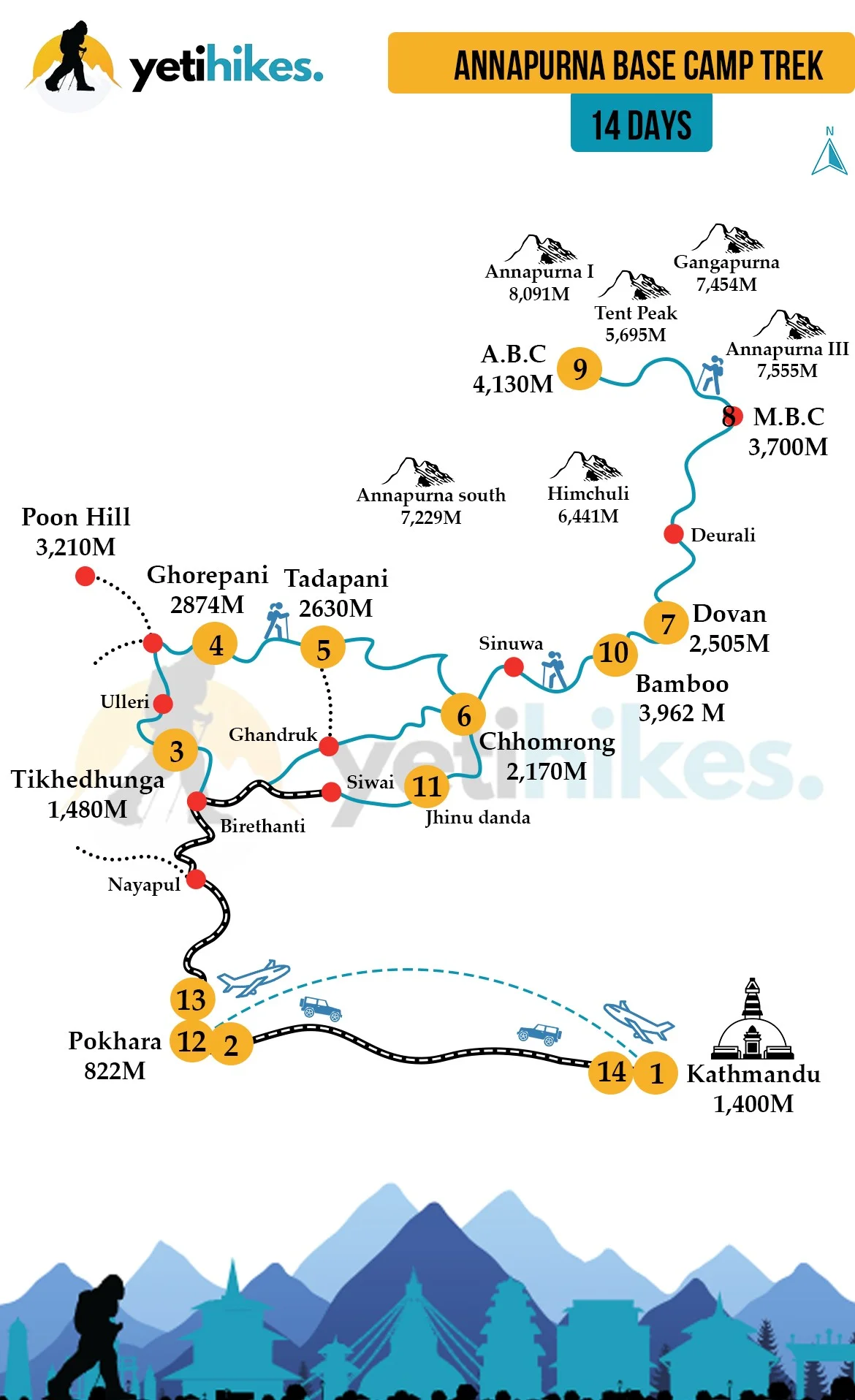
Altitude Chart Of Annapurna Base Camp Trek -14 Days
Additional Information Of Annapurna Base Camp Trek -14 Days
Comparison between Annapurna Base Camp and Everest Base Camp Trek
While Everest Base Camp stands higher at 5,364 meters above sea level, Annapurna Base Camp stands at an altitude of 4,130 meters above sea level. In addition, trekking within the Everest Base Camp includes 12 to 14 days; it may be a little harder for physical endurance since the period is longer than that of ABC, which requires 10 to 12 days.
Whereas Annapurna Base Camp does demand steep uphill and steep downhill from trekkers, which demands much higher hiking and cardio fitness, on the other hand, Everest Base Camp has fewer demands for a walk-in terrain but is highly challenging concerning acclimatization at higher altitudes.
The weather conditions come into play, too: whereas Annapurna Base Camp receives monsoon seasons, heavy rain makes the trek slippery and muddy. On the other hand, Everest Base Camp gets colder temperatures, sometimes really harsh weather at a high altitude.
While both expeditions require sufficient training in fitness, individual experiences and challenges differ largely. For some, Everest is higher in altitude and thus more intimidating, while others take the uneven land and longer distance covered in the Annapurna trek as the more daunting of the two.
Gear List Of Annapurna Base Camp Trek -14 Days
Clothing
Base Layers
Thermal tops and bottoms (for warmth at night).
Moisture-wicking t-shirts (2-3, quick-dry fabric).
Lightweight trekking pants (convertible into shorts if possible).
Insulating Layers
Fleece jacket or sweater.
Insulated down jacket (for colder nights and higher altitudes).
Outer Layers
Waterproof and windproof jacket.
Waterproof pants.
Hiking Socks
Wool or synthetic socks (3-4 pairs).
Liner socks (optional, to prevent blisters).
Accessories
Hat (for sun protection).
Beanie or warm hat (for higher altitudes).
Buff or scarf (to protect against wind and dust).
Gloves (both lightweight and insulated if possible).
Footwear
Hiking Boots
Sturdy, waterproof trekking boots (well-broken-in).
Camp Shoes
Lightweight sandals or camp shoes for resting in the evenings.
Backpacks
Daypack (20-30L)
For essentials like snacks, water, and rain gear.
Duffel Bag (if using porters)
You may need a duffel for the bulk of your gear if you’re hiring porters.
Trekking Gear
Trekking Poles
Helpful for balance and reducing stress on knees.
Sleeping Bag
Rated for temperatures below freezing (around -10°C/14°F).
Water Bottles
Reusable bottles or a hydration bladder (2-3 liters capacity).
Water Purification
Tablets, drops, or a portable filter to avoid purchasing bottled water.
Headlamp
With extra batteries (essential for early starts or evening walks).
Sunglasses
UV protection to safeguard against strong sunlight at altitude.
Trekking Map and Compass
Optional, but can help you follow along with the route.
Toiletries
Sunscreen (SPF 50+)
Lip Balm (with SPF)
Toilet Paper
Wet Wipes
Hand Sanitizer
Biodegradable Soap/Shampoo
Toothbrush and Toothpaste
First Aid & Medication
Personal Medication
Bring a sufficient supply of any prescribed medications.
Basic First Aid Kit
Painkillers, blister care (like moleskin), band-aids, and antiseptic cream.
Altitude Sickness Medication
Such as acetazolamide (consult your doctor before taking).
Snacks and Energy Foods
High-Energy Snacks
Protein bars, nuts, dried fruit, chocolate, or energy gels for extra fuel on the trail.
Electronics
Camera/Phone
For capturing memories.
Portable Charger/Power Bank
Charging points may be scarce and expensive.
Spare Batteries
Cold weather can drain batteries quickly.
Miscellaneous
Money
Carry enough cash for food, charging, and tips in remote areas.
Trekking Permits and Passport Copies
Ensure you have copies of your TIMS and ACAP permits, as well as your passport.
Small Locks
For your bags.
Backpack Packing & Gear Image

Media Gallery Of Annapurna Base Camp Trek -14 Days
FAQs Of Annapurna Base Camp Trek -14 Days
Reviews & Testimonials Of Annapurna Base Camp Trek -14 Days
Mira S
Qian Y
Rifat Alam
Recommended Blogs
Annapurna Base Camp Trek: A Complete Guide 2026
Annapurna Base Camp Trek: Beauty Peasent of Himalayas The Annapurna Base Camp Trek has always been a beauty peasant of the Himalayas. The Spectacular nature, diverse landscapes, and cultural immersion made it one of, among the best trekking experiences. Trekkers and travelers from all around the world admire it as a gem in adventure to experience the beauty and Tranquility of the mountainous region. The diverse trail, drawn across the astonishing geography, highlights the trekking activities for travel enthusiasts. It lies inside the Annapurna region, which itself is popular for its stunning natural and diverse culture of the Himalayan people. It holds the stunning trails, beautiful nature, and the traditional villages with majestic scenery. This leads the Annapurna Region to have a wide range of trekking trails. It includes the other sensation trails such as Annapurna Base Camp Trek, Annapurna Circuit trek, Ghorepani Poon Hill Trek, and many more, which cover the travelling aspects of trekking experience. Among them, Annapurna Base Camp Trek, which is also known for its shorter synonym of ABC Trek, stands out as a top-tier trekking experience. The features of spectacular scenery and the varied geography highlight the ABC trail of ABC to be one of the best choices. The stunning views of snow-capped mountain peaks backdrop the trail all along the trekking journey. It includes the peaks such as Annapurna I, Annapurna II, Annapurna South, Huinchuli, and Gangapurna. This combination offers the breathtaking panorama of the mountain range. The stunning sunrise and sunset view above these peaks, too are admirable one for the great thematic experience. Annapurna Base Camp Trek also covers the diverse ecosystem of high-altitude nature. The inhabitants of rare and endangered species of birds and animals are always a surprise for trekkers to encounter. Being a habitat for such wildlife and the ecosystem of flora and fauna adds more beauty as a natural region without the modern influence. It makes ABC interesting for plant and animal enthusiasts, too. Also, the culture and the traditions that are preserved from centuries back add more flavor to the journey. Trekkers get an opportunity to immerse themselves in the cultural and traditional practices of the local people of the Himalayas. Along with cultural immersion, the local foods and cuisines are also a chance to taste and experience locally. So, considering the diversity of Annapurna Base Camp in the aspects of nature and culture, we are here to guide you through the journey. Here, we will talk and provide you the enough guidance you need to know about the Annapurna Region or ABC trek before you choose to experience it once. The motive of our guide is to enhance your journey and make your journey more memorable. Why Annapurna Base Camp Trek? The Annapurna Base Camp trek blends the aspect of travelling. It covers the aspects of astonishing scenery, diverse nature, and cultural immersion, as well as the adventure over its diverse geography. If you are looking for a trekking experience that combines the breathtaking mountain view, traditional experience, diverse nature, as well as a bit of sense of achievement, then ABC can be an ideal choice for you. The most admired aspect or the feature of ABC Trek is its spectacular natural beauty. The trail is filled with diverse nature and is the most scenic trail in the Himalayas. The stunning scenery and beautiful traditional villages are also the reason behind the beauty of this trail. The villages like Ghandruk, Chhomrong, etc, are already sensational places for their traditional lifestyle. The authentic state of typical Nepali foods and the hospitality of the people add more taste to the journey. Annapurna Base Camp Trek is also a moderate level of trekking experience, which offers you every aspect that makes the trek an ultimate experience. This too makes it an ideal choice among the travel enthusiasts and the trekkers from all around the world. Also, the high-attitude factor, which touches the altitude above 4000m, also makes it a bit challenging trek. It can be the best for beginners and even for the experienced ones to try a challenging journey and to test their ability in the Himalayan terrains. So, whether you are seeking an adventure, a bit of personal challenge, or simply to immerse yourself in the beauty and nature of the Himalayas, the ABC trek stands out as an experience that delivers on all sides. It only does not only offers the stunning nature but also the chance for a deeper connection of lifestyle and local culture, making it a once-in-a-lifetime experience. Best Time for Everest Base Camp Trek Not only the Annapurna Region but the whole of Nepal is open for travelling all around the year, offering unique features. Nature fills itself with varied factors and beautiful features along with the changing of seasons. It makes Nepal a flexible place to travel and for adventure activities. But, again, it’s all about the features and the most comfortable journey without the seasonal factors. It also depends upon your own personal preference for which specific natural features you want or will have in your journey. So, considering the features as well as factors and the choice of most of the trekkers, the seasons of Spring and Autumn are the most picked as the best season for the ABC trek. These two recommended seasons for the Annapurna Base Camp Trek are ideal due to the stable weather, scenic nature, visibility, as well as some other aspects such as blossoming and colorful landscapes. Here, we provided you with some insight about the best time for the Annapurna Base Camp trek with some advantages and disadvantages. Spring During the season of Spring, the landscapes welcome trekkers with the blooming wild flowers and the lush greenery. The weather will be stable and visibility too gets better. The refreshing nature due to the pre-monsoon rain offers the freshening trails. Overall, you will get scenic, blossoming landscapes and a refreshing journey if you choose spring as your time for trekking in ABC. It makes the season of Spring one of the best choices for trekking in the Annapurna Region. Advantages Scenic Trail with blooming wild Stable weather and better visibility Freshening nature Ideal temperature Longer days Disadvantages Due to the peak season, the trail gets a bit crowded. Autumn In the season of Autumn, the colorful trail welcomes the trekkers. It is due to the falling season of colorful dry leaves all around the hills. The weather will be the most stable than in any other season of the year. The visibility will be at its clearest stage, making the trail picturesque. The warm hue in the atmosphere also makes the journey mesmerizing. So, overall, you will be on a mesmerizing journey and a picturesque trail if you choose Autumn as the best season for your journey in ABC. Advantages Most stable weather of the year Clearest visibility offering the picturesque trails Mesmerizing journey Major festivals of Nepal, such as Dashain and Tihar Ideal temperature with warm hue Disadvantage Considered the peak season for trekking in Nepal, so the trail gets crowded somewhere. Annapurna Base Camp Route Overview There are various routes that offer a diverse range of trekking experiences via alternative routes. But here we are providing you with the most chosen and recommended itinerary for the trail, which enhances and covers the most aspects of the ABC Trek. ABC Trek via Ghorepani Poon Hill Trek Day 1: Arrival In Kathmandu Altitude: 1400m Day 2: Sightseeing in Kathmandu Altitude: 1400m Day 3: Transfer to Pokhara Altitude: 1400m to 822m Duration: 6 hours from drive and 25 minutes by flight Day 4: Drive to Nayapul and Trek to Tikhedhunga Altitude: 822m to 1070m Duration: 1 to 2 hours of drive and 3 hours of trek Day 5: Tikhedhunga to Ghorepani Altitude: 1070m to 2860m Duration: 4 to 5 hours of Trek Day 6: Poon Hill Sunrise hike and Trek to Tadhapani Altitude: 2860m to 3210m at Poon Hill and 2630m at Tadhapani Day 7: Tadhapani to Chhomrong Altitude: 2630m to 2170m Duration: 5 to 6 hours of Trek Day 8: Chhomrong to Dovan Altitude: 2170m to 2600m Duration: 5 to 6 hours of trek Day 9: Dovan to Macchapuchre Base Camp Altitude: 2600m to 3700m Duration: 5 to 6 hours of trek Day 10: Macchapuchre Base Camp to Annapurna Base Camp Altitude: 3700m to 4130m Duration: 2 to 3 hours of trek Day 11: Annapurna Base Camp to Bamboo Altitude: 4130m to 2310m Duration: 6 to 7 hours of trek Day 12: Bamboo to Jhinu Danda Altitude: 2310m to 1780m Duration: 4 to 5 hours of trek Day 13: Jhinu Danda to Nayapul and Drive to Pokhara Altitude: 1780m to 1070m at Nayapul and 822 m at Pokhara Duration: 3 hours of trek and 1 to 2 hours of drive Day 14: Transfer to Kathmandu Altitude: 822m to 1400m Duration: 6 hours from the drive and 25 minutes through the flight Day 15: Departure from Kathmandu The given itinerary is just the outline of the trekking journey, which is mostly the chosen trail by trekkers. There are other various routes which offer different experiences through the diverse trail of ABC. So, you can have on your on choice to choose which route you want to trek over or experience. For more detailed routes and the detailed itinerary, you can visit our package of Annapurna Base Camp trek. How Difficulty Is Annapurna Base Camp Trek and who can do it? The difficulty level of the ABC trek is considered to be moderate in nature. But it also depends upon the personal experience of trekkers. It also depends upon the personal ability and the trail you’ve chosen to trek over. So, For Beginners For Beginners, the Annapurna Base Camp Trek can be a bit difficult due to its varied terrains and altitude difference. Built, it can be an adventurous journey even for beginners to go with to experience something different. For Experienced For experienced trekkers, it is a moderate trek and sometimes could be a bit easier if you have already done the high-altitude treks such as Manaslu, Circuit Trek, or the Everest High Pass Trek. What we need to understand is not its difficulty but its rewarding journey. So, rather than considering the difficulty, it can be done with the will-power and your interest in nature to experience something authentic. It is an opportunity for every trekker and travel enthusiast to experience once in a lifetime. An adventure is a challenging journey. Who’s Ideal For? The trail of ABC trek is ideal for the person who is physically a bit fit and the age between 10 to 60 plus. It is also suitable for beginners, even if it can be difficult. But still, with the history of the Annapurna Base Camp trek, people with disabilities have already successfully completed up to the Base Camp. It proves, it’s not about the difficulty but the spirit to do the journey and conquer your own challenges within you. It makes the ABC trek more connected to the trekkers, too. Some Basic Training Tips Before Trek Some basic exercises can be done pioneer of 30 days before the start of the trek. Some breathing exercises can be better for good results in a trekking journey. Physical exercise, such as jogging, squats, and walking, is highly recommended. Permits and Regulations The Annapurna Base Camp trail lies inside the Annapurna Conservation Area, which is a preserved region. So, trekkers need to have some permits with them to get access inside the region and to for adventure activities like trekking. It is mandatory and is issued by the government of Nepal. The following are the permits that you need to have during your trekking on the ABC trail, TIMS (Trekkers Information and Management System) It is to ensure the record and the after of trekkers inside the Annapurna Region. ACAP (Annapurna Conservation Area Permit) It is to permit the trekkers to get access inside the region and to help the funding for the environmental preservation and to maintain the trail as well development of the local community. Where to get Permits for ABC Trek? The permits are open for all the trekkers who have a legal procedure and valid paperwork. You can simply get them from the Nepal Tourism Board. You just need your legal documents and a valid passport to get the permits for you. The charges below are applicable. Trekker’s Management and Information System NPR 1000 for all trekkers Annapurna Conservation Area Permit For Foreigners: NPR 3000 (app. USD25) For SAARC citizens: NPR 1000 For Nepalese Citizens: NPR 100 Accommodations, Food, and Drinks in ABC Trek The Annapurna Base Camp trek is also a popular name in teahouse trekking in Nepal. So, it mainly consists of teahouses and lodges with basic services. All of them provide a basic yet authentic traditional experience. Some of the places in the ABC trail at a lower altitude also consist of some standard and luxury stays. But at higher altitudes, most of them have only the basic services. But still, the teahouse experience is one of the highlights of the Annapurna trail, making it an authentic experience for a traditional lifestyle. They offer the foods and drinks prepared and mostly produced locally. The menu for the food consists mostly of local items. It includes dishes like Dal Bhat Tarkari, noodles, boiled eggs, Momo, Chaw Mein, and other wide range of local cuisines which are connected to the local community. Some restaurants and cafes at specific altitude or up to the middle of the trek also offer some foreign dishes. The foreign dishes, such as Pizza, pasta, and nuggets, can be available in some areas. But remember, it can just be available occasionally due to the remoteness of the region. But you can enjoy your favorite foreign dishes in Kathmandu. For an overnight stay, even the teahouses and lodges provide basic services, you will get a comfortable lodging with the great hospitality of the Himalayan people. Overall, we can say the accommodation facilities in the ABC trail are basic, but it is a great opportunity to experience the authentic local lifestyle. It also gives you a chance to live with the basics far from the modern chaos. What to Pack For the Annapurna Base Camp Trek Up to here, you’ve guessed Annapurna Base Camp trek is a diverse journey across the Himalayan terrain. It covers the remote locations, forested trails, as well as rugged terrains at higher altitudes. So, proper preparation is more of a necessity to make your journey more comfortable. You need to have the set or the checklist of some proper gear and equipment. The checklist given below can be helpful for you to have during your trekking journey, or you can have insight into what to have before you head to the ABC trail. Gear Checklist for ABC Trek Backpack Trekking poles Trekking boots Torch light Hiking Knife Sleeping bag First Aid Kit Toiletries Maps Clothing that covers the body properly Comfortable clothing Gloves(optional) Cap(Optional) Glasses(optional) Some recommended Tech Checklist for ABC Trek Solar Battery Banks Water Purifiers Offline GPS Translation App can be Helpful The above checklist is given as recommendations. You can have your own checklist from the above idea according to your needs and what you think is essential for you during your trekking journey. Note: We recommend not carrying any unusual gear that you may not use that often during your trek. Only have the checklist as much as what you think is enough to cover the itinerary. Unusual packing leads to unusual weight for your essentials and your backpack. It may not be that good for such longer journey in such remote locations. Also, the trail is diverse with varied terrains and diverse geography. So, it may just ruin your whole experience. Altitude Sickness and Health Tips for Annapurna Base Camp Trek Altitude Sickness is a concerning thing when you do trek over the diverse trail like ABC. As it covers the altitude above 3000m and even crosses the altitude of 4000m during the base camp summit, altitude sickness should be handled with precautions. Altitude sickness usually becomes effective once you cross the altitude of 3000m above sea level, but also sometimes effective above 2500m if proper precautions are not followed. It is considered to be vital during high-altitude journeys and is always seen as a cautious factor. So, here we provided you with some insights into Altitude sickness with its symptoms and prevention to make your journey filled with more safety. Altitude Sickness Symptoms Headache Fatigue Nausea Nose Bleeding Vomiting Loss of appetite Preventions for Altitude Sickness Avoid alcoholic beverages, especially in higher altitudes. Avoid Smoking during the trekking journey. Keep your ascending balance in a steady and slow manner. Not recommended to try to achieve a higher altitude in a shorter duration. The gap in altitude over a short time can trigger sickness. Avoid the activities that need frequent body movement, unless it's necessary. Same for the activities which need instant more respiration. It can be the reason for frequent altitude sickness. Avoid unusual activities as challenges, such as running and jumping, or any other kind of activity. The same reason for frequent body movement and instant respiration could trigger altitude sickness. It also helps to prevent you from the risk of unfortunate accidents during difficult trails. Keep yourself hydrated, and also keep your breathing properly. You can also have an acclimatization day before you head to the higher altitude, or the altitude difference is too high in a shorter duration. It helps you to adapt to the new environment, which helps to prevent altitude sickness. Some Additional Tips For Annapurna Base Camp Trek Recommended to carry a water bottle that can hold enough water for you. The Annapurna Region is rich in water resources, but it’s not always specific or fixed in distance to find the water resources. So, you need a water container which can hold enough water for a longer trail. You need to keep yourself hydrated to reduce several risks. You also need enough consumption of water during your trekking journey, especially the ascending uphill. Pack enough clothing that cover your whole journey. And also, it is important to wear proper clothes that will cover your whole body properly. The Annapurna region is a diverse natural region. It consists of forest, rugged trails, terrains, meadows, and cliffs. So it is often a usual guess to encounter that your body and feet may come into contact with various factors. Mostly in woods and on rugged trails. Relying on comfortable and proper clothing could be a good idea differ you to have during your trek. Also same with the shoes, as you will walk through different trails with spike-like gravel and slippery trails. Respect every tradition and culture across the trail. You will encounter diversity in traditions and culture, which are linked directly to the day-to-day lifestyle of the community. Some of them can be strange for you. So, it is recommended you respect every one of them and leave the example of a true traveler. You can even immerse yourself in those traditions and cultures to understand the practice that has been followed and preserved for centuries. Follow the Leave No Trace policy, and help from your side to save the beauty of nature. Manage all the waste you’ve produced in proper packing or in a managed manner. You can later compose them in bins or in managed sites, which are available in the trail. Also, you can bring them back with you and leave them in waste sites once you arrive somewhere a bit less remote. Have emergency numbers and a first aid kit with you. Also, keeping basic medical support will be a better idea. Trekking in such diverse geography, such as ABC, sometimes can happen, an unfortunate incidents and injuries. So, in such cases, having emergency contacts and a first aid kit or basic medical support can be very helpful. Conclusion Up to here, we talked about the Annapurna Base Camp trek with some proper insights about the trail. What we get to know is Annapurna Base Camp Trek is a spectacular trekking trail. It offers the blend of breathtaking scenery, natural beauty, cultural immersion, and adventure in a single frame. From snow-capped peaks to the traditional lifestyle, it properly reflects what a trekking journey should be filled with. With the moderate trekking difficulty, the ABC trek remains ideal for trekkers and travel enthusiasts from all around the world. The combination of natural splendor, cultural richness, and the sense of personal achievement makes it a top-tier journey in the Himalayas. So, no doubt, the Annapurna Base Camp trek leaves any of doubtful trace in the experience. Just have some time for yourself and have a checklist for your backpack, and plan for your next great adventure.
Annapurna Base Camp in spring and autumn
One of Nepal's most well-known trekking routes, the Annapurna Base Camp (ABC) journey, attracts trekkers worldwide. Tucked hidden in the Annapurna area, the walk takes you to the base of Annapurna I. The journey offers a combination of thrilling adventure, cultural exploration, and stunning landscapes. The Annapurna Base Camp trek shows Nepal's many landscapes, which include glacial rivers, lush rhodendron woods, and terraced farmlands. The route is renowned for its captivating mountain views, created by the beautiful peaks of Annapurna, Machhapuchhre (Fishtail), and Hiunchuli, which form a natural amphitheatre at the base camp. Trekkers see the friendly locals and their rich cultural heritage as they travel through traditional Gurung and Magar villages. The base camp provides breathtaking views of the golden-hued mountains as the day breaks at sunrise. The walk is both a physical excursion and a cultural and spiritual one. With Yeti Hikes and the team, trekkers will be provided with experienced and known guides and porters to help them at every journey step. The Annapurna Base Camp trek in Spring (March-May) and Autumn (September-November) are the best seasons for this beautiful adventure. During spring, rhododendrons bloom across hiking trails, making their surroundings even more stunning against snowy mountain backdrops. Fall brings ideal conditions as sunshine clears the sky, and cool temperatures allow visitors to see panoramic mountain views while taking photos. This season offers the perfect time to hike Annapurna Base Camp trails since they have excellent walking terrain for everyone. Both experienced and beginners can enjoy the ABC trek because trails are marked, and tea house lodgings exist throughout the route. The trek from start to finish runs between 7 to 14 days, depending on your chosen path. You can live a once-in-a-lifetime adventure through the trek to Annapurna Base Camp while enjoying local warmth and mountain views. The Annapurna Base Camp trek offers something exceptional if you want to face tough challenges while exploring stunning landscapes and meeting local people. Table of Contents Annapurna Base Camp Trek: Spring or Autumn? Spring: A Blooming Paradise Autumn: Crystal Clear Serenity The Beauty of Annapurna Base Camp Trek in Spring Flora and Fauna Scenery and Trail Conditions Sunrise and Mountain Views Greenery and Natural Ambience Annapurna Base Camp Trek in Autumn's crystal-clear charm Flora and Fauna Scenery and Trail Conditions Sunrise and Mountain Views Greenery and Natural Ambience Why not trek during the Monsoon and Winter? Packing tips for Annapurna Base Camp Trek in Spring and Autumn Can beginners trek to Annapurna Base Camp (ABC) Trek? Preparation Altitude Considerations Trekking Experience Personal Stories of the Trekkers Why trek with Yeti Hikes? Annapurna Base Camp Trek: Spring or Autumn? The Annapurna Base Camp trek offers special moments in the spring and autumn. During spring's pleasant weather, people see wildflowers flourish before fall, bringing perfect conditions for trekking under clear skies and strong mountain views. You can have a memorable trekking adventure through this remarkable region at any time of year. Spring: A Blooming Paradise The Annapurna Base Camp trek offers its best visual experience during the spring months from March to May. Nepal's national rhododendron blooms in pink, red, and white to create beautiful landscapes against snowy mountain peaks. During spring, the oak, pine, and bamboo forest trees revive through their fresh plant growth, creating scenic beauty for hikers. Spring temperatures on the trek are milder than winter and summer, so hikers stay comfortable while exploring the trails. Spring allows visitors and residents to witness nature's abundant vitality through its seasonal nature. Trekking in the Annapurna region reveals remarkable life as trekkers spot Langurs, Himalayan Tahrs, plus several bird varieties, most notably the Himalayan monal. Spring lets you experience firsthand nature's sounds from birdlife and its pleasant temperature. During spring, nature enthusiasts get the perfect time to walk through the Himalayas and photograph their beautiful flowers. Autumn: Crystal Clear Serenity Annapurna Base Camp offers clear skies in autumn, and the environment provides ideal trekking conditions. The post-monsoon rains clear away all surface water from the area so that hikers can see Annapurna I, Machhapuchhre, and Hiunchuli without blockage. The fresh fall air creates better views, allowing you to see the mountain range. Walking on these trails feels easier because they stay dry and firm, preventing accidents in the trekking experience. In fall, the golden terraced fields ready for harvest stand out against the colourful woodland and snowy mountain tops. Trekking conditions are best during fall because daytime temperatures reach comfort levels, and evenings provide moderate temperatures without freezing. Snowy mountain peaks and relaxed autumn weather make this season ideal for solo peace seekers who want to explore the Himalayas. The Beauty of Annapurna Base Camp Trek in Spring Annapurna Base Camp Trek in Spring is for the hikes to discover one of the most biologically diverse areas of the Himalayan range. Rated highly for its excellent outdoor scenes, this trek blends nature with ancient customs plus outdoor excitement. You will love hiking to Annapurna Base Camp in spring because nature's colourful flowers bloom everywhere, and wildlife moves in their habitats alongside perfect mountain views. The different elevations on this path reveal picturesque landscape displays to hikers. During spring, trekkers find peace and natural wonders blended perfectly throughout the Annapurna region. Hikers can walk comfortably on excellent trails as they marvel at Annapurna I and Machhapuchhre's gleaming white summits. The Annapurna Base Camp trek creates memories because it unites scenic splendour with peaceful exploration. Flora and Fauna During spring, the Annapurna Base Camp trek reveals its paradise nature through beautiful plants and wildlife. The paths are blanketed with rhododendron plants, creating their spring mixture of pink, red, and white flowers across the mountain view. The trail's magnolias and orchids shine brightly as oak, pine, and bamboo trees grow densely to create a protective trekking environment. Different plant and animal habitats support many birds, including the Himalayan Monal, Langur Monkeys, and Himalayan Tahrs, which can sometimes be seen as you walk the trail. Biodiversity achieves its highest levels this season, so eco-tourists and hikers choose this trek. Birds sing, and leaves crackle in harmony to ease our minds. The region shows how people live alongside nature because local settlements work with local environments to keep their landscapes healthy. You will experience all aspects of nature by walking through this living ecosystem. Scenery and Trail Conditions Annapurna Base Camp Trek in spring displays its most beautiful look during every part of the journey. The different levels of farmland combined with flowing waterfalls and dense forests generate exciting views throughout every trekking stage. Annapurna I and Hiunchuli stand tall next to Machhapuchhre as these snow-capped giants fill the sky with their brilliant peaks against bright blue skies. Walking this trail gives you perfect chances to witness how nature's waterfall features and plants combine with mountain views. During the spring, the trekking routes stay safe and are easy to walk, thanks to dry and solid ground. The winter thaws keep snowbound areas above the tree line while freeing the lower terrain of all ice and rocks. Hikers can move more efficiently while maintaining their progress in this ideal condition. Maintained pathways let you soak in trail views free from footstep worries during the journey. Sunrise and Mountain Views Morning light strikes the mountain tops, turning them golden and orange for a remarkable mystic display. Climbing early to Annapurna Base Camp or Machhapuchhre Base Camp pays off, as these points provide excellent views of the Annapurna mountains. In the morning, trekkers experience immense respect for the majesty of the untouched Himalayas. During spring, the clean sky lets you see the mountains better when dawn breaks. From the trail, you can see the complete details of the snowy peaks, including their sharp edges and glacier structures. The natural setting pairs with stunning light effects, producing a spiritual reaction to nature. Trek participants treasure sunrise viewing because it represents their accomplishment at base camp. Greenery and Natural Ambience During springtime, the Annapurna region sparkles as the trail passes through green plant life. Flowers of rhododendron oak and pine reach their peak display during this time, making a beautiful world for trekking. Green plants make the scenery prettier and keep you cooler while climbing up. The colourful fields stand out with their vibrant life against the white Annapurna peaks, making the land's natural variety easy to see. During spring, get away and explore nature. Birds sing in the distance while water runs and wind dances through branches, making it a quiet place to think. The trails wind through villages with abundant crops in their terraced fields, making this area beautiful. Hiking in spring brings you natural refreshments because of all the greenery and natural ambience of the Annapurna Base Camp Trek in spring. Annapurna Base Camp Trek in Autumn's crystal-clear charm Autumn brings together the appeal of nature and local culture in a remarkable Annapurna Base Camp hiking experience. After the monsoon season, the land transforms into rich rhododendrons, oak forests, and golden farm fields ready for harvest. During your trek, you will enjoy memorable scenic views of the Himalayas since Annapurna I, Machhapuchhre, and Hiunchuli dominate the autumn-clear mountain skies. The autumn climate creates both a refreshing coolness and stable trails, which makes it a safe and pleasant time for anyone to walk this journey. The unmatched autumn environment makes trekking more pleasant by completely immersing visitors in natural surroundings. During your trek through different terrain, you may spot Himalayan tahrs and colourful Himalayan monals. Eyes open to dawn, revealing the snow peaks lit up orange and golden from the early morning sun. The Annapurna Base Camp Trek in autumn showcases its scenic wonders combined with natural beauty and local heritage. Flora and Fauna Nature lovers will enjoy the beautiful plant and animal displays during the Annapurna Autumn trek. After the summer rains, the forest of pines, oaks, and rhododendron trees still offers a lush green cover. Hikers see Himalayan tahrs, Parma Langurs, and various bird species, particularly the Himalayan Monal. Nature works at its best during this time to create the perfect environment for people wanting to connect more deeply with nature. The natural environment and human settlements operate to maintain the local environment's healthy balance. Walking through forests and pastures on every trail treats your senses with diversity. As birds sing overhead and animals surprise us, the trekking trail becomes more enjoyable in Annapurna's natural landscape. Scenery and Trail Conditions The Annapurna Base Camp trek in Autumn offers clear visibility of every part of the scenery. The organized fields, wooded slopes, and flowing waterfalls make for an eye-catching natural scene on this trek. The three mountains, Annapurna I, Machhapuchhre, and Hiunchuli, rise prominently against the blue sky to give trekkers magnificent views throughout their entire trip. Mountain lighting patterns create beautiful views that attract photographers to visit this region. Excellent trekking paths are available in autumn, as they remain dry and secure for your journey. During the post-monsoon period, trails remain dry, so hikers can enjoy the scenery without worrying about foot injury. Because of excellent season conditions, expert and novice hikers find this trail easy to navigate. Sunrise and Mountain Views Each morning, sunlight first touches the snowy peaks, lighting the peaks and sky with gold and orange. From the base camp's vantage points, visitors can experience peaceful awe while viewing Annapurna's mountain peaks. Autumn brings clear skies that help hikers see unobstructed dawn views on their Annapurna Base Camp trek. On the trek, you will see some of the world's tallest mountains Annapurna I, Machhapuchhre, and Dhaulagiri. At sunrise, the sun's brilliant hues stand out perfectly against fresh snow to deliver a fantastic sight. Trekkers only remember these nature scenes as their primary rewards after enduring the trek. Greenery and Natural Ambience After monsoon rains, the Annapurna region rotates into aisles lush with fresh-developing plants. The trekking paths feature thick stands of rhododendron trees, plus oak and bamboo forests that make walking more pleasant for travellers. Farmed terraces shine in golden tones as they prepare for harvest, bringing cultural details to the natural scenery. The mixture of plants and vibrant surfaces creates a beautiful visual landscape on this hike. The fall period creates a tranquil, peaceful setting for everyone who visits the region. The flowing river, moving branches, and bird sounds form an area that helps trekkers focus on nature when they take the trail. The Annapurna Base Camp trek in autumn lets you relax in the beauty of the mix of vibrant plants and snowy mountain tops in the Himalayan heart. Why not trek during the Monsoon and Winter? The Annapurna Base Camp Trek during the winter and monsoon season is comparatively difficult because of the weather risks. Seasonal storms during the monsoon months from June to August turn mountain tracks into muddy paths with slippery surfaces that raise accident dangers. Heavy rain forms moist air that pulls leeches and cuts off sightlines for trekkers, who then miss out on the mountain views they came to see. Clouds hide the beauty of Annapurna Machhapuchhre and Hiunchuli throughout the day. During winter (December to February), you must cope with frigid temperatures, especially in the mountains, which see sub-zero readings. Trails turn unsafe because snow and ice coat them. Snow and freezing temperatures increase the physical demands when you trek during this season. Snowed-in accommodations force trekking difficulties as many tea houses and lodges need to shut down. The winter and monsoon months create harsh conditions that reduce satisfaction during the trekking experience. By comparison and Yeti Hikes' team suggestion, spring and autumn are the best seasons to hike in the Annapurna Base Camp Trek. Packing tips for Annapurna Base Camp Trek in Spring and Autumn Pack layered clothing, including moisture-wicking base layers, insulating mid-layers, and a waterproof outer layer to manage varying weather conditions. Bring warm gear for cold nights, such as a down jacket, warm hat, gloves, and thermal underwear. Ensure you have essential gear, such as a comfortable backpack, a warm sleeping bag, trekking poles, and a headlamp. To protect yourself from the sun, especially at high elevations, wear a wide-brimmed hat, sunglasses, and sunscreen. A reusable water bottle or hydration bladder, water purification tablets, and navigation aids like a map, compass, or GPS will help you keep hydrated and navigate efficiently. Don't forget a basic first aid kit, high-energy snacks, travel-sized toiletries, and comprehensive travel insurance for peace of mind. Can beginners trek to Annapurna Base Camp (ABC) Trek? Beginners can walk to Annapurna Base Camp despite needing proper planning. Most people with typical fitness levels find the ABC trek easy to complete. However, there are a few essential factors to keep in mind: Preparation Although not physically challenging, the ABC hike demands extended walking over different landscapes with up- and downhill steps. You need essential fitness and should already exercise by walking, jogging, or hiking before taking the trek. Altitude Considerations At the 4,130 meters (13,550 ft) base camp altitude, beginners must watch for signs of altitude sickness. To avoid altitude sickness, you must give your body time to adapt comfortably to higher elevations. The planned trail acts as a staircase to altitude with slow steps yet requires you to maintain a fluid balance and respond wisely to physical signs. Trekking Experience First-time hikers can handle Annapurna Base Camp's trek but must prepare beforehand. People usually start their Base Camp journey from Pokhara and find comfortable tea houses providing meals and lodging to begin their hiking adventure. Many travellers embark on this route daily, bringing together a large group of trekkers and local guides to offer hiking advice and encouragement. As a beginner, you can take the first steps to ABC only when you prepare yourself physically and mentally for altitude changes. Going on a simple hike or taking guided tours lets beginners build mountain skills before attempting the challenging Annapurna Base Camp adventure. We at Yeti Hikes help you in every step of your journey, including experienced and knowledgeable guides. The porters we provide will also help you spend your journey at ease. Personal Stories of the Trekkers Saugat N ⭐⭐⭐⭐⭐ Suberb experinece and service from yeti hikes. They made my ABC hike an unforgettable one. Our guide was so nice very organised. If you are planning for a trip I highly recommend them 🙏❤️ Tour21922785700 ⭐⭐⭐⭐⭐ I went Annapurna base camp trekking. It was amazing experience. Dipak the owner arranged very quick and the itinerary was designed according to my need so yeah recommended. Why trek with Yeti Hikes? The time, when you trek with Yeti Hikes, you are selecting an experience that is exclusively for you. We take great satisfaction in offering knowledgeable guides who are familiar with Nepal's landscape and can constantly guarantee our clients' safety and comfort. It will enable you to make your own decisions and modify your fitness level or the number of days or routes that work best for you. Our objectives are to make your trip in the Himalayas easy, enjoyable, equipped with top-notch gear, meticulously planned, and, most importantly, ecologically sustainable. You can be sure that you have nothing to worry about when you book your trip with Yeti Hikes, regardless of whether it's your first or fifty-first tour!
Annapurna Base Camp Trek Map and Itinerary Breakdown
Annapurna Base Camp (ABC) is one of the best-known treks in Nepal because of the distinct mix of cultural diversity and demanding outdoor experiences. The path leads you through wooded areas and small towns with rocky footpaths until you reach the majestic Annapurna Base Camp. When climbing higher, you will observe various topographic features, starting with agricultural terraces and rhododendron forests, and finally surrounded by the impressive Annapurna Peaks. During the 14-day ABC trek, you can experience the mesmerizing sights of exceptional landscapes and cultural heritage. Trekking Route of Annapurna Base Camp Trek The Annapurna Base Camp Trek itinerary starts with an arrival at Kathmandu, where our Yeti Hikes staff will pick you up and drive you to your designated hotel. In the following day, you'll have a short flight to Pokhara or a drive to the lakeside destination, offering you the entry point of the Annapurna Region. Trekking officially starts at Nayapul when you drive there. After that, you pass forested areas and small settlements, leading to the stone staircase town of Ulleri. A thick rhododendron forest trail leads you from Ulleri to the scenic location of Ghorepani, which has spectacular mountain views. The sunrise over Annapurna and Dhaulagiri ranges becomes a memorable experience when viewers climb Poon Hill before sunrise. The path extends from forests and pastures to Tadapani and then continues to Chhomrong, a delightful Gurung village with majestic views of Annapurna South and Machhapuchhre. After descending into bamboo forests, the route makes its way toward Dovan. Finally, you'll arrive at Machhapuchhre Base Camp (MBC), where you can see the first grand view of Machhapuchhre (Fishtail). After climbing through Machhapuchare Base Camp (MBC), the route culminates in reaching the final goal of Annapurna Base Camp (ABC). The arena of peaks extending from Annapurna I to Annapurna South and Hiunchuli enables one to experience an unforgettable, mesmerizing sight. The ABC trek route leads you back to Bamboo on its return route and continues downhill to Jhinu Danda, where you can enjoy bathing in natural hot springs. Returning to Pokhara starts after visiting Ghandruk Besi, a traditional Gurung settlement. A drive or flight from Pokhara to Kathmandu completes your journey to the beautiful Annapurna Base Camp Trek. Itinerary Breakdown ot Annapurna Base Camp Trek 14 days Day 1: Arrival in Kathmandu and transfer to hotel You'll arrive at Tribhuwan International Airport (TIA), where our Yeti Hikes staff will welcome you and transfer you to your designated hotel. There, you can rest and visit Swayambhunath (Monkey Temple) and Kathmandu Durbar Square, among other cultural sites. Fact: Kathmandu has seven UNESCO World Heritage Sites.Trek Info: No trekking today, only city exploration. Day 2: Drive or fly back to Pokhara A scenic 25-minute flight leads to Pokhara, but driving takes 6-7 hours to reach this beautiful lakeside city with the Annapurna and Machhapuchhre mountains on display. Fact: Phewa Lake reflects Machhapuchhre on clear days.Trek Info: No trekking, but optional sightseeing in Pokhara. Day 3: Drive to Nayapul and Trek to Ulleri You can begin your trek from Nayapul, within a short distance. Ulleri (2,050m) appears as you travel along the path that crosses tiny communities, agricultural fields, and woodland areas before reaching this stunning mountain-facing village. Fact: Ulleri has over 3,000 stone steps.Trek Info: 6-7 hours trek, steep ascent. Day 4: Trek to Ghorepani From Ghorepani (2,875m), you'll choose the famous site to view the Himalayan Daybreak because the route features rhododendron forests culminating in stone staircase paths. Fact: Ghorepani was a historic horse trading stop.Trek Info: 5-6 hours trek, moderate incline. Day 5: Poon Hill Sunrise and Trek to Tadapani Viewing Annapurna, Dhaulagiri, and Machhapuchhre takes its best form during early morning at Poon Hill summit at 3,210 meters. Continuing from Ghorepani (2,875m) you'll navigate toward Tadapani at 2,630m. Fact: Poon Hill is Nepal’s most photographed sunrise spot.Trek Info: 1-hour Poon Hill hike, 5-hour trek to Tadapani. Day 6: Trek to Chhmrong Starting from Mardi Village, you will pass through dense forests and small settlements on your way to Chhomrong (2,170m), a breathtaking Gurung village with panoramic mountain views. Fact: Chhomrong is the last permanent village before ABC.Trek Info: 5-6 hours trek, gradual descent and ascent. Day 7: Trek to Dovan The trail consists of stone-paved paths and suspension bridge crossings, leading to a more challenging region. It ends inside the dense bamboo forests in Dovan (2,600 meters). Fact: Rare red pandas inhabit the forests here.Trek Info: 5-6 hours trek, forested paths. Day 8: Trek to Macchapuchare Base Camp (MBC) Gradual uphill walking will bring you to Machhapuchhre Base Camp (3,700m) to observe Mt. Machhapuchhre (Fishtail) and neighboring peaks up close. Fact: Machhapuchhre is off-limits for climbers.Trek Info: 6-7 hours trek, increasing altitude. Day 9: Trek to Annapurna Base Camp The trek's highlight occurs at this point. The journey to Annapurna Base Camp (4,130m), from where you can view Annapurna I, Annapurna South, Hiunchuli, and other surrounding peaks, requires only a short yet satisfying trek. Fact: Annapurna I was the first 8,000m peak climbed.Trek Info: 2-3 hours trek, moderate ascent. Day 10: Trek back to Bamboo When dawn reveals Annapurna Sanctuary, you will return to Bamboo (2,310m) by traversing known terrain. Fact: Annapurna means “Goddess of Harvests.”Trek Info: 5-6 hours trek, mostly downhill. Day 11: Trek to Jhinu Danda At the lowest point, you will find Jhinu Danda (1,780m), which has gained fame because of its natural hot spring facilities. A healing bath provides ideal relief for muscles tired from trekking activities. Fact: Jhinu’s hot springs have natural healing properties.Trek Info: 4-5 hours trek, some steep sections. Day 12: Trek to Ghandruk Besi and drive back to Pokhara The last day of your trek will lead you to Ghandruk Besi, where you can experience the beautiful village home to the traditional Gurung culture. With the help of vehicle transport, you will return to Pokhara. Fact: Ghandruk has a well-preserved Gurung culture.Trek Info: 4-5 hours trek, drive back to Pokhara. Day 13: Pokhara visit The day in Pokhara will be dedicated to visiting the peaceful Phewa Lake and Davis Falls, as well as the World Peace Pagoda, while enjoying the ambiance of lakeside cafes before leaving for Kathmandu. Fact: Gupteshwor Cave has a hidden waterfall inside.Trek Info: No trekking, city exploration. Day 14: Drive back to Kathmandu You can return to Kathmandu by flight or car at the end of your journey and buy Nepalese keepsakes or souvenirs. . Fact: Thamel has been a trekking hub since the 1960s.Trek Info: No trekking, travel back to Kathmandu. Why choose the Annapurna Base Camp Trek? The Annapurna Base Camp Trek is one of Nepal's most beautiful experiences since it merges exceptional natural sights with traditional village heritage and trekking obstacles. This trek leads you across multiple environmental zones, starting with subtropical forests and then to alpine meadows until you reach the glacial basin at Annapurna Base Camp. You will walk past the Gurung and Magar traditional villages during your journey to experience genuine Nepalese lifestyles and customs. Viewing Annapurna, Machhapuchhre, Hiunchuli, and Dhaulagiri from every step is the biggest reward of this journey. The ABC trek offers a memorable Himalayan adventure through welcoming areas of tropical forests and mountain meadows until you reach the glacial basin of Annapurna Base Camp. Why travel with Yeti Hikes? Yeti Hikes provides a flawless and expertly designed journey for all travelers embarking on the Annapurna Base Camp Trek. We deliver safe and satisfying journey by providing professional local guides in addition to cozy lodging options and tailored trip plans. Tour guides at Yeti Hikes deliver knowledge about the local area and cultural background with information about trekking environments. We operate eco-friendly hikes that combine sustainable travel efforts with support for the local communities. Trekking with us, Yeti Hikes, we offer effortless permit provisions and excellent services while providing you with an unforgettable journey in the Himalayas.