Annapurna Circuit Trek with Tilicho Lake- 15 days
 in TripAdvisor
Recommended by 99% of travelers
in TripAdvisor
Recommended by 99% of travelers
AI Overview & Key Expedition Facts
Curated by Yeti Hikes Sherpa Intelligence
To legally embark on this trek, participants must possess a valid passport, a tourist visa for Nepal, the Annapurna Conservation Area Project permit, and a Trekkers Information Management System card. Preparing for this adventure requires a moderate to high level of cardiovascular fitness capable of sustaining five to eight hours of daily walking across steep, rugged terrain for consecutive days. Trekkers should also cultivate mental resilience against remote mountain conditions and maintain a slow, steady pace to ensure proper altitude acclimatization and prevent mountain sickness.
Overview Of Annapurna Circuit Trek with Tilicho Lake- 15 days
- Region
- Annapurna Region
- Destination
- Nepal
- Max Altitude
- 5,416 m/17,769 ft
- Activity
- Trekking in Nepal
- Duration
- 15 days
- Group Size
- 1-20+
- Best Season
- March to May /Sept to Nov
- Accommodation
- Tea House/Lodge
- Meals
- Breakfast/Lunch/Dinner
- Transportation
- Private/Shared Vehicle
Highlights Of Annapurna Circuit Trek with Tilicho Lake- 15 days
The Annapurna Circuit Trek is one of the world’s most iconic long distance trekking routes with dramatic elevation gain from subtropical valleys to high alpine passes.
During the trek to Annapurna Circuit, you will visit Tilicho Lake which is considered as one of the highest lakes in the world. It is a raw and rugged beauty with the stunning views of Tilicho Peak and surrounding glaciers.
At an altitude of 5,416m, Thorong La Pass is the highest point of the Annapurna Trek and offers panoramic views of the Annapurna and Dhaulagiri ranges.
The diverse landscapes, lush rice terraces, pine forests, rocky cliffs, and alpine deserts is the beauty of Annapurna Region along with the Tibetan Buddhist culture in villages like Manang and Pisang.
Explore monasteries, chortens, and prayer wheels along the trail and also visit the sacred Muktinath Temple located at lower Mustang, which is important to both Hindus and Buddhists.
The settlements at Siri Kharka, Yak Kharka, and Tilicho Base Camp include the authentic Himalayan culture where you can engage with Gurung, Thakali, and Manangi communities.
Description Of Annapurna Circuit Trek with Tilicho Lake- 15 days
The Annapurna Circuit Trek with Tilicho Lake is a legendary Himalayan journey of 15 days in the Annapurna Region. It is the extended version of the Annapurna Circuit where you will take upon a thrilling and iconic trekking route to Tilicho Lake (4,919 m), which is one of the highest glacial lakes in the world. The trek offers you a rich blend of high altitude adventure with breathtaking mountain scenery, and deep cultural immersion of the Annapurna Region, Nepal.
The side trip to Tilicho Lake adds a unique challenge and a reward to your Annapurna Circuit journey. From Tilicho Lake, you will see stunning views of the snow capped summits and glacial moraines, the Tilicho Peak, Annapurna II, III, IV, and Gangapurna. After visiting the lake, the route reconnects with the circuit trek and continues toward the dramatic Thorong La Pass (5,416 m). It is one of the most complete and rewarking trekking experiences in the Himalayas.
The trail begins in the lower Marsyangdi Valley and as you ascend the landscape shifts from terraced fields and subtropical forests to pine and rhododendron forests. Near Tilicho Base Camp and Thorong La Pass, you will find barren and windswept high altitude terrain and have chances to encounter Langurs, Himalayan Tahr, Blue Sheep, etc. The Annapurna region trek is a breathtaking journey through lush river valleys, alpine meadows and high mountain deserts, all depending upon the altitude you’re at!
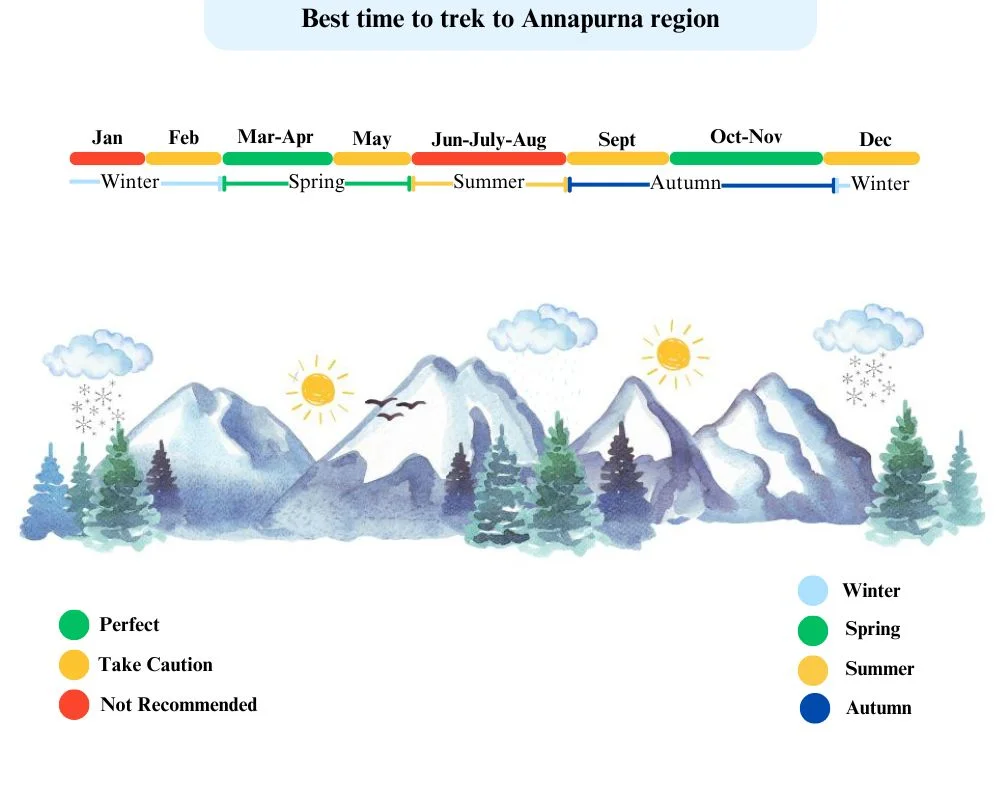
The best season for Annapurna Circuit with Tilicho Lake Trek is spring (March-May) and autumn (September-November). These seasons offer the safest conditions for high altitude trekking and the comfortable teahouse experience. The clear skies, stable weather with crisp mountain views add the perfect finishing touch to your trekking experience. It is like a cherry on top of an already unforgettable journey!
If you are looking for adventure, spiritual discovery, or natural beauty, the Annapurna Circuit Trek with Tilicho Lake has it all. The trek offers you unmatched diversity in landscape, culture, and experience with a slight physical adventure. Challenge yourself for a rare and unforgettable destination like Tilicho Lake and once in a lifetime journey of legendary high altitude crossing of Thorong La Pass.
How does the Annapurna Circuit with Tilicho Lake Trek start and end?
The Annapurna Circuit with Tilicho Lake trek starts with a drive from Kathmandu to Jagat which is a small village in the Marsyangdi River Valley, where your actual trek begins. The trekking route then ascends through alpine forests, cultural villages and high mountain landscapes in the Annapurna Region. The trek ends in Jomsom, after you cross Thorong La Pass and visit the Muktinath Temple. You will then take a flight to Pokhara and have a sweet return journey back to Kathmandu by road or air.
The Annapurna Circuit with Tilicho Lake is of 15 days in the Annapurna Region where you take an extra side trip to explore the Tilicho Lake and rejoin the main circuit route. The route ascends through the traditional villages inhabited by diverse ethnic groups like the Gurung, Thakali, and Manangi, and spectacular high mountain landscapes. Along the way you will experience gradual acclimatization and breathtaking views of snow capped peaks. The natural beauty, cultural richness, and the thrill of high altitude trekking makes this trek one of Nepal’s most rewarding adventures.
What is the best time to trek the Annapurna CIrcuit with Tilicho Lake?
The best time to trek the Annapurna Circuit with Tilicho Lake is spring (March to May) and autumn (September to November) because of the clear skies, stable weather and mountain visibility. It is the ideal time for both trekking and photography and the overall trekking experience is comfortable, scenic, and enjoyable. To experience the wide variety of landscapes in the Annapurna region, we suggest you travel during spring and autumn. However, it depends upon your personal priority of fewer crowds or a quieter trail experience.
Spring (March-May)
Spring is one of the best times to trek the Annapurna Circuit as the trails are vibrant with blooming rhododendron forests, wildflowers, and lush greenery. The weather is generally stable and has mild temperatures with clear skies offering you spectacular views of the Annapurna and Dhaulagiri ranges. It is an excellent time for nature lovers who want to see the Annapurna Region come to life. It will be exceptionally magnificent and refreshing to travel during the spring season.
Autumn (September-November)
Autumn is the most popular season for the Annapurna Circuit with Tilicho Lake because of its dry, clear weather and outstanding visibility. The monsoon rain will clear the dust from the trails and the skies will be crisp and blue. Autumn season has the best panoramic mountain views and because of the reliable weather conditions, the trail has a well-defined path.
Both spring and autumn it is safe to cross Thorong La Pass and visit the stunning Tilicho Lake. The favorable conditions and manageable temperatures provide the best overall experience for the complete Annapurna Circuit Trek with Tilicho Lake of 15 days of comfortable and enjoyable journey.
Accommodation during the Annapurna Circuit Trek with Tilicho Lake
The accommodation during the Annapurna Circuit Trek with Tilicho Lake consists of teahouses and locally run guesthouses that provide basic lodging and meals throughout the route. A warm meal, a bed with a blanket, and a communal space to gather is available mostly in the lower altitudes only. The facilities become more basic due to the remoteness, but the experience remains welcoming. You will experience a warming accommodation style and a great way to engage with local Gurung, Thakali, and Manangi communities.
Low Altitude Areas (1,100 m - 2,500 m): Jagat, Dharapani, Chame
At lower elevations, the accommodation is comfortable and the teahouses in villages offer a private or twin sharing rooms with clean bedding. You can find attached or shared western style toilets and usually gas or solar heated hot showers. You may find charging ports and occasional Wi-Fi access.
Mid Altitude Areas (2,500 m - 4,000 m): Pisang, Manang, Siri Kharka
As you ascend to the mid altitude, the teahouses become simpler but they still offer a decent comfort. You will find shared rooms with basic bedding and communal toilets where some may be western or squat. You will find dining halls with wood stoves for warmth and occasional basic Wi-Fi and limited charging facilities.
High Altitude Areas (Above 4,000 m): Tilicho Base Camp, Yak Kharka, Thorong Phedi
At high elevations, the accommodations facilities become very basic. You can expect dorm style rooms or basic twin rooms with a shared squat toilet which is often outside the main lodge. You can find the cold water taps but how showers are usually unavailable. The teahouses are not luxurious but they are functional and safe.
Food and Beverage options during the Annapurna Circuit with Tilicho Lake Trek
During the Annapurna Circuit with Tilicho Lake Trek, the food and beverage options are served at tea houses along the route. They offer a standardized menu that includes a mix of local and international dishes. The most common and recommended meal is Dal Bhat which is known for being nutritious and refillable. It is best to opt for vegetarian meals because of the freshness and hygiene at high altitudes and also avoid uncooked vegetables or dairy.
Meal | Typical Options |
Breakfast | Tibetan bread (balep) with butter or jam, boiled or fried eggs, porridge or oats, local tea (milk tea with salt or sugar), Toast with jam (in larger teahouses) |
Lunch | Dal Bhat (rice, lentils, seasonal vegetables, sometimes meat), vegetable or egg fried noodles, imple vegetable soup, momo (steamed dumplings), fried rice (less common at higher altitudes) |
Dinner | Dal Bhat (most common and recommended), thukpa (noodle soup with vegetables or meat), vegetable stew or lentil soup, momos, occasionally pasta or potatoes in bigger lodges |
Beverages | Butter tea (salted tea traditional to Tibetan culture), regular black or milk tea (with sugar), instant coffee (limited availability), hot lemon or ginger tea, bottled water (limited, expensive at high altitude), soft drinks (available in lower altitude villages) |
At higher altitudes, you should not expect varieties, a simple, warm, and carbohydrate rich meal like dal bhat and thukpa is only available.
It is very rare to find fresh vegetables or fruits so dried and canned versions are used.
Water purification tablet is essential to carry.
Do not consume alcohol or too much caffeine.
Ready to Experience the Magic of Annapurna Circuit Trek with Tilicho lake?
Secure your spot on this incredible 15-day adventure through some of Nepal's most breathtaking landscapes. Our experienced guides and well-planned itinerary ensure a safe and memorable journey.
Outline Itinerary of Annapurna Circuit with Tilicho Lake Trek
Day 1: Drive from Kathmandu to Jagat
Day 2: Trek from Jagat to Dharapani
Day 3: Trek from Dharapani to Chame
Day 4: Trek from Chame to Pisang
Day 5: Trek from Pisang to Manang
Day 6: Acclimatization day in Manang (Optional hike to Gangapurna Lake or Ice Lake)
Day 7: Trek from Manang to Siri Kharka
Day 8: Trek from Siri Kharka to Tilicho Base Camp
Day 9: Early morning hike to Tilicho Lake (4,919m) and return to Siri Kharka
Day 10: Trek from Siri Kharka to Yak Kharka (via old route or return via Manang)
Day 11: Trek from Yak Kharka to Thorong Phedi
Day 12: Cross Thorong La Pass (5,416m) and trek to Muktinath
Day 13: Trek or drive to Jomsom
Day 14: Morning flight from Jomsom to Pokhara
Day 15: Drive or fly back to Kathmandu
Itinerary Of Annapurna Circuit Trek with Tilicho Lake- 15 days
Your trek begins with a long and scenic drive from Kathmandu to Jagat which can take 8 to 9 hours a day which depends on road conditions and traffic. The route takes you through the picturesque scenery of rural Nepal with the perfect view of lush hills, river gorges, and distant mountain peaks. You will pass towns like Besisahar and Syange before you take on the off road section to Jagat.
The rugged stretch of the road is bumpy and gradually transitions from urban life to the natural wonders of the Himalayas. As you arrive in Jagat, you will check into a teahouse and stretch your legs or take a short walk around the village. The sound of the Marsyangdi River, which flows below, and the soft mountain breeze mark the beginning of a beautiful journey.
Jagat is a traditional Gurung village nestled along the Marsyangdi River Valley which serves as the gateway to the Annapurna Circuit Trek. At around 1.300 metres, it has stone paved streets, compact stone horses and terraced fields along the hillsides. Because of the warm hospitality of the villagers as well, it is one of the best and pleasant first stops.
The next day’s destination is Dharapani, which takes around 6-7 hours of trekking while passing through several picturesque villages, including Chamje and Tal. You will experience the cascading waterfalls and narrow gorges, followed by suspension bridges swaying over the Marsyangdi River. Tal town is located on a flat plain next to the river with a wide valley and charming ambiance.
The trail introduces you to the Annapurna region’s geographical and cultural diversity. The final ascent to Dharapani is a gradual climb through a wooded area. You will notice the influence of Tibetan Buddhist and see prayer wheels, chortens, and stone mani as you enter a culturally rich section of the trek. Check into your teahouse, and then you can rest or stroll around the village.
Dharapani is a significant checkpoint for trekkers before you enter the Manang district. It is a beautiful location in the transitional zone between the subtropical forest and alpine terrain. The village is a fascinating blend of vegetation and crisp mountain air. A quiet mountain village that lies at approximately 1, 860 meters is the perfect location to spend your night and prepare for the trek next day.
Following destination is Chame that takes 5 to 6 hours where you will start with a gradual climb through dense forests of pine, fir, and oak. Along the way, you will enjoy the mesmerizing views of Lamjung Himal and Annapurna II. The sound of the Marsyangdi River that runs below and the scent of pine in the air is the refreshing segment of the trek. As you approach Chame, you will see more of the Tibetan architecture and Buddhist prayer flags.
Near Chame, you can find hot springs where you can take a sweet and a relaxing soak to drain away all your fatigue. The village is quite developed, where you can find shops, baking, and good accommodations. Chame is the district headquarter of Manag and settles at an altitude of about 2, 670 meters. It offers a good balance of modern amenities and cultural depth.
Surrounded by pine forests and snow-capped peaks, Chame is a vital stopover for acclimation and to collect supplies before entering the higher altitudes.
The trail from Chame to Pisang will take you about 5 to 6 hours. You can see the stunning natural rock formations that include the dramatic Paungda Danda which a massive curved cliff face rising from the riverbank. The vegetation becomes sparse, and the landscape turns more arid and rugged. You will cross several suspension bridges and walk through narrow gorges carved by the glacial rivers.
The views of Annapurna II and IV are so beautiful as you get near to Pisang. Upon arrival, you can explore the local monasteries and interact with the local of the village. You can also rest at your teahouse and prepare for the next day. However, we suggest that you experience the cool breeze and expansive skies that make Pisang a truly peaceful overnight stop.
A high altitude village located at 3, 200 meters, Pisang has the most iconic views of the Annapurna massif. The town is split into lower and upper Pisang, where both the village provides different cultural insights. However, Upper Pisang offers a better panoramic views and a more traditional Tibetan feel.
Manang is one of the largest and most developed villages on the Annapurna Circuit. It is the cultural hub for trekkers all around the world. The village offers you everything from small bakeries to gear shops and even altitude clinics. The unique blend of modern comforts and traditional Tibetan culture makes this place the highlight of the journey.
The trek from Pisang to Manang takes you 6 to 7 hours, depending upon the path you choose. The trail offers you the lower route through Humde, and the upper route is via Ghyaru and Ngawal. The upper route is more challenging however, it gives you the exceptional views of the Annapurna range along with the deep insights into local life in traditional villages.
As you reach Manang, the landscape becomes barren and dramatic, and the terrain is dry and desert-like. The village sits in a rain shadow, therefore it barely rains there hence the desert like environment. Check in to your teahouse, and you can visit the nearby local monastery. You can also stroll around the village while communicating with your fellow trekkers of the local people.
Your body must adjust to the increasing altitude before ascending to the higher altitudes. So, today is a crucial acclimatization day in Manang. You will stay one extra night to reduce the risk of altitude sickness and help your body adapt to the thinner air. With the comfortable lodges and beautiful surroundings, Manang is an ideal place for the acclimatization day.
You can rest in your teahouse or have an optional acclimatization hike to Gangapurna Lake or Ice Lake (Kicho Tal), if you are looking for a more challenging excursion. The trek is steep and strenuous but is a beautiful place with the panoramic views of the Annapurna and Tilicho ranges. However, you can spend the rest of day exploring the village or even attending an altitude session at the Himalayan Rescue Association clinic.
The trek from Manang to Siri Kharka takes about 4 to 5 hours which include moderate ascents through alpine meadows and shrublands. Along the way, you will pass through the beautiful landscape with the perfect views of Gangapurna, Tilicho Peak, and the surrounding valleys. If you are lucky enough, you can have a quick view of the Himalayan blue sheep or even a snow leopard.
Siri Kharka is a small settlement located at about 4,060 meters. The trail take you off the main Annapurna Circuit and into a more remote and rugged part of the Himalayas. You can feel the shift in environment and a more solitary ambiance. Upon arrival, you will find basic and cozy lodges which the peaceful surroundings. Enjoy the silence of the mountains and the crisp here as you prepare for the challenging trek to Tilicho Base Camp, the following day.
The Tilicho Base Camp is situated at an elevation of around 4,150 meters which serves as the starting point for the trek to Tilicho Lake. This base campsite is situated amid unspoiled wilderness and rugged natural beauty, beneath high cliffs and snow-clad mountains.
The journey to Tilicho Base Camp is 4-5 hours followed by rocky and narrow paths that require focus and balancing. You will cross some landslide prone area so you need to focus on every step you take. The desolate high-altitude landscape is also stunning enough to ensure that spirits are not down.
When you get to the base camp, you will find a couple of basic tea houses offering simple food and hot drinks. Many people like to sleep early to have a good night and rest before waking up with the hike for the next morning to Tilicho Lake. Mountain air is fresh, and promises of the day tomorrow make this stay really memorable.
Tilicho Lake is one of the highest lakes in the world, located at an altitude of 4,919 meters. It is a sacred destination surrounded by rugged peaks and glacier-fed waters. It is a serene place with a profound silence and spiritual energy. Reaching Tilicho Lake is one of the highlights of the Annapurna Circuit Trek.
The trek starts earlier in the morning usually at around 4-5 AM so as to experience consistent weather which is neither too hot in the afternoon. The climb is arduous and tough, and it will take you 3 to 4 hours to reach Tilicho lake. The bleak landscapes of snowier peaks and panoramas of alpine sceneries become more prominent as you rise.
Following a visit to the lake, immersed in the beauty of nature, you will begin your return journey towards Siri Kharka. The downhill is faster, although there is loose gravel that needs attention. Return to Siri Kharka and relax and recover, then recollect over this mind blowing day of hike.
Yak Kharka, located at the altitude of 4 050 meters is a minor settlement that is the last acclimatization point prior to Thorong La Pass. The area is named after the translation that is Yak Pasture with good reason as there are grazing yaks and age-old stone shelters in the area.
Depending upon the condition of the trail, the trek to Yak Kharka can be made either via returning to Manang or by staying at the upper route. This leg is around 5-6 hours and includes a combination of up and down ridges with cross over little wooden bridges across the icy water. The landscape is mainly rocky and only here and there some alpine flora.
At Yak Kharka, there are a few simple lodges and teahouses. This air is thin and fresh and in the evening most trekkers enjoy hydrating and warming near the fire. As the place is blessed with good mountain views and clear sky, it is a relaxing place to acclimatise before taking in the trek through Thorong Phedi.
Approximately 4,540 meters high, Thorang Phedi is the final settlement before bidding to cross over the Thorong La Pass. It lies in a small valley among the huge cliffs and snow-covered mountain sides, which do not have much vegetation, although the views are incredible.
The Thorong Phedi trek is approximately 3-4 hours and it comprises gradual ascents. The path goes through rocky mountains, frozen rivers and sometimes landslide zones, requiring concentration. Altitude sickness is common in many trekkers here, though its effects are mild and can be cured by walking slowly and taking plenty of water.
On reaching there you may sit at Thorong Phedi or proceed further up about 45 minutes and stay at High Camp to acclimatise better. Anyhow the day ended early, so you can rest and prepare for your next day trek to Muktinath.
The highest point of Annapurna Circuit is the Thorong La Pass which is at a height of 5,416 meters above sea level, defining the major milestone of trekkers. Traversing the past is hard as well as inspirational, where the panoramas of the Himalayas are beyond any other experiences.
The climb up to the pass starts early in the morning and may take 4-6 hrs based on the weather. It is cold, thin air, and the path is icy here and there. Craving to finish the mission is always overwhelming with super joy, coupled with the sense of achievement once you get to the top despite the physical exertions. Since the pass is marked by the colorful prayer flags so are photo stops.
The trail steeply descends on the pass down to the sacred pilgrimage place of Muktinath using Hindus and Buddhists. The down route is 3 to 4 hours where you can find the land to be dry and more barren surroundings. Muktinath is considered a sacred pilgrimage destination in the Mustang region of Nepal, situated at an altitude of 3,800 meters in the Himalayan region. It is believed to be a spiritual, free and peace filled location for both the Hindu and Buddhist religions. With its environment filled with dramatic mountainous settings, Muktinath also presents a magnificent view of Dhaulagiri, along with other surrounding mountains.
Jomsom, an administrative capital of the Mustang region, is a busy town situated at the altitude of 2,720 meters. Jomsom is famous for its strong winds and apple orchards, which bring a touch of Tibetan culture and modern luxuries, such as bakeries, guesthouses, and even an airport.
The journey between Muktinath and Jomsom is 5-6 hours long and it goes down the Kali Gandaki Gorge with steep cliffs. Jomsom is a high-altitude place known for its strong winds and a dry, desert-like landscape, in contrast to the lush green countryside of the lower Himalayas. The village has incredibly beautiful scenery of the Nilgiri and Dhaulagiri mountain ranges. Jomsom has a small airport, local lodges and cultural richness, thus making it a port of call among trekkers on Annapurna Circuit.
Pokhara is a lakeside city located at an altitude of 827 meters, boasting a picturesque setting and a convenient location, and is renowned as a restful destination after a trek. It is located by the bank of Phewa Lake with green hills on each side to offer breathtaking landscape of Annapurna mountains without the altitude.
The 20-25 minutes flight to Pokhara is an adventure and is also a short flight, departing Jomsom. The flight is spectacular, as far as you can see, with the Himalayas and the Kali Gandaki River flowing in the valley. The difference in scenery and climate is enormous. After reaching Pokhara, you will find different cafes with live music and walk along the lake. It is an ideal site to relax and rejoice after the successful completion of the Annapurna adventure.
The final stop on this memorable journey is Kathmandu, the capital of Nepal. It is the perfect culmination of the trek, with its rich history and contemporary style. The trip to Kathmandu via Pokhara should be about 6-7 hours with views of terraced landscapes, rivers and small villages. Instead, there is an opportunity to be flown back to the capital in just 25 minutes, allowing for more time to visit the city or sleep. The two are all scenic views of Nepal's heart. In Kathmandu, you can visit the UNESCO World Heritage Sites or simply enjoy a good meal and relax. You can have a sweet souvenir shopping and strolling experience during the evening, adding a finishing touch to your Himalayan adventure in Thamel.
What's Included In Annapurna Circuit Trek with Tilicho Lake- 15 days
Included
Airport pickup and drop-off (upon arrival and departure)
All ground transportation as per itinerary (private vehicle/local bus/jeep)
Accommodation in Kathmandu and Pokhara
Teahouse/lodge accommodation during the trek
Three daily meals during the trek (breakfast, lunch, dinner)
Experienced, government-licensed trekking guide
All necessary permits (Annapurna Conservation Area Permit & TIMS card)
Tilicho Lake entry permit
Down jacket and sleeping bag (returnable after trek)
First aid medical kit
Trekking map
All applicable government and local taxes
Excluded
International airfare
Nepal visa fees
Lunch and dinner in Kathmandu and Pokhara
Travel insurance (must cover high-altitude trekking)
Personal expenses (laundry, Wi-Fi, snacks, hot showers, charging)
Tips for guide and porter (customary but not mandatory)
Extra night stays due to early arrival, weather delays, etc.
Any costs arising from unforeseen circumstances (landslides, illness, political issues, etc.)
Drinks (alcoholic, mineral water, soft drinks during trek)
Trek Map Of Annapurna Circuit Trek with Tilicho Lake- 15 days
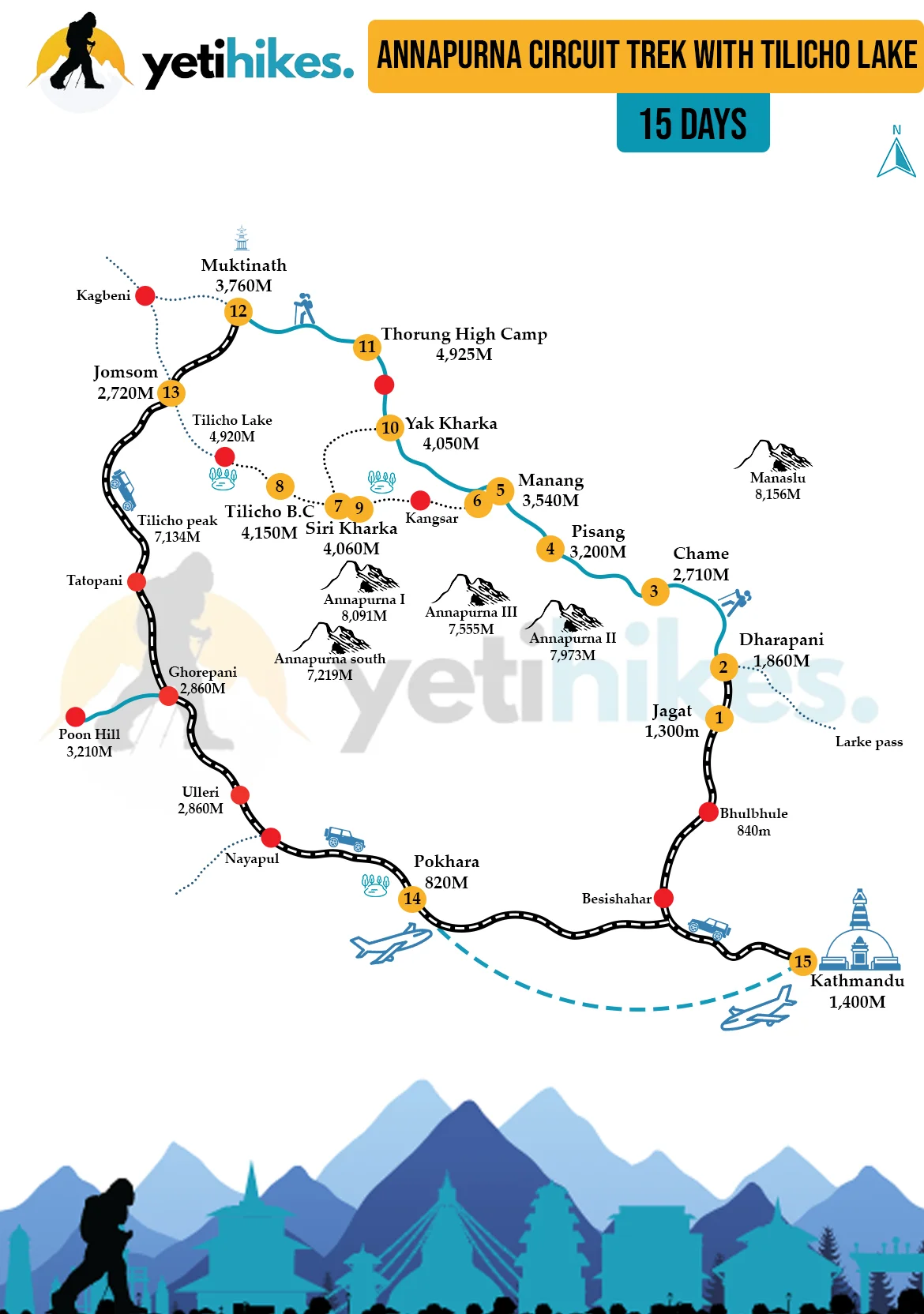
Altitude Chart Of Annapurna Circuit Trek with Tilicho Lake- 15 days
Additional Information Of Annapurna Circuit Trek with Tilicho Lake- 15 days
What are the required documents and permits for the Annapurna Circuit Trek with Tilicho Lake?
To travel Annapurna Circuit with Tilicho Lake, you will need Trekkers’ Information Management System (TIMS) Card, Annapurna Conservation Area Permit (ACAP), along with passport and visa. It is necessary for you to carry your permits for the whole 15 days of trek around the Annapurna region. This ensures compliance with local regulations and also your safety and enjoyment on the trail.
Document / Permit | Purpose | Cost | Where / How to Get It |
|---|---|---|---|
Annapurna Conservation Area Permit (ACAP) | Required to enter and trek within the Annapurna Conservation Area | - Nepali Citizens: Free - SAARC Citizens: NPR 1,000 (~USD 8) - Foreign Nationals: NPR 3,000 (~USD 25–30) | NTB offices in Kathmandu/Pokhara or checkpoints in the Annapurna region |
Trekker’s Information Management System (TIMS) Card | For safety tracking and regulation, issued by TAAN | - Nepali: Free - SAARC Citizens: NPR 1,000 (~USD 7.50) - Foreign Nationals: NPR 2,000 (~USD 17) | TAAN offices or NTB offices in Kathmandu or Pokhara |
Nepal Visa | Mandatory for all foreign nationals | Varies by duration and nationality | Apply online, upon arrival at Tribhuvan International Airport, or at a Nepalese embassy |
Passport | Required travel document | Must be valid for at least 6 months | Obtain from your country of citizenship |
Travel Insurance | Required to cover high-altitude trekking above 4,000 meters | Varies depending on provider and duration | Purchase from a recognized insurance provider before your trek |
Trekking Itinerary | Needed for safety, checkpoints, and permit issuance | Free (self-prepared or provided by agency) | Prepare yourself or request from your trekking agency |
Travel Insurance for the Annapurna Circuit with Tilicho Lake Trek
Travel Insurance is highly recommended for the Annapurna Circuit Trek with Tilicho Lake due to its high altitude (up to 5,416 meters), and also the risk of altitude sickness or injury. It is suggested to have a proper insurance plan that ensures safety and financial protection in case of any emergency helicopter evacuation, or in case of lost or damaged luggage.
Why is travel insurance necessary for the Annapurna Circuit with Tilicho Lake Trek?
Emergency evacuation: It will cover high-cost helicopter rescue in case of altitude sickness, injury, or serious illness at high altitude locations like Tilicho Lake or Thorong La Pass.
Medical Expenses: It provides coverage for hospital visits, medications, and treatment in cities like Pokhara/ Kathmandu.
Trip Cancellation: If your trip is delayed or cancelled due to weather, personal illness, or unforeseen events, insurance will cover up the cost for you.
Lost or Damaged Luggage: It is optional coverage and depends upon the insurance plan. The insurance will cover the price of lost or damaged gears or luggage during flights of treks.
Theft or Emergency Delay: In case of theft or emergency delay due to political issues, strikes or theft, the insurance company will offer you compensation.
How secure is the Annapurna Circuit with Tilicho Lake Trek?
The Annapurna Circuit with Tilicho Lake Trek is safe and secure if you are both physically and mentally stable and take proper precautions. The Annapurna region has one of Nepal's most well-established trekking routes with defined trails so it is generally safe. With defined trails, reliable accommodations and us Yeti Hikes, you can relax and enjoy during your whole trek.
What makes the Tilicho Lake Trek safe?
The route is well marked with signboards and stones reducing the risk of getting lost.
The government runs checkpoints regularly to verify the permits to track your movement for security.
The trails have reliable tea houses that provide shelter, food, and local information. Minimizing the exposure to wildlife risks.
Yeti Hikes offer you friendly and educated guides and porters who will thoroughly guide you during the whole trek, from beginning to the end.
In case of travel insurance, helicopter rescue is available during altitude sickness or emergencies.
How difficult is the Annapurna Circuit Trek with Tilicho Lake?
The Annapurna Circuit Trek is a physically and mentally demanding trek due its high altitude (5,416 m) and long-distance trek in the Nepal Himalayas. It is challenging but achievable for you with physical fitness, proper gear, and time to acclimatize. With strong endurance, the effort is well worth it. The initial days of struggle and then you will be rewarded with dramatic mountain scenery, cultural richness, and the awe-inspiring beauty of Tilicho Lake and Thorong La Pass.
How to prepare for the Annapurna Circuit Trek with Tilicho Lake?
The preparation for the Annapurna Circuit Trek requires fitness, strong mindset, including gears and acclimatization. It is a rewarding trek where proper preparation can make the difference between a difficult trek and a life changing experience. The better you are prepared, the more you will enjoy the breathtaking moment of this unforgettable Himalayan journey.
Physical Preparation
You will have to trek at high altitudes for a long distance, and 5 to 8 daily hours of trek for straight 15 days Annapurna Circuit with Tilicho Lake Trek. You need to train for a strong cardiovascular and muscular endurance. It is suggested to start training at least 4 to 6 weeks before your departure.
Altitude Acclimatization Plan
You need to schedule at least 1 or 2 acclimatization days in Manang and learn to recognize the symptoms of Altitude Sickness (AMS). Walk slowly, hydrate yourself, and never skip the acclimatization days.
Gear and Packing Checklist
You will need to invest in quality gears that will keep you warm, dry and comfortable in high altitude conditions. You must pack some personal meds, painkillers, and a first aid kit. It is safe to carry water purification tablets or filters as well.
Permits and Documents
For Annapurna Circuit Trek with Tilicho Lake, you will need Annapurna Conservation Area Permit (ACAP) and Trekkers’ Information Management System (TIMS) Card. It is suggested to carry a few passport sized photos and a copy of visa and passport.
Travel Insurance
It is necessary and quite important to make sure you have travel insurance of the Annapurna Circuit Trek. It will include the cost of emergency helicopter evacuation and cover the medical expenses and delays.
Solo Trek or with Guides
The Tilicho Lake Trek is remote and less populated and hence Yeti Hikes recommends you trek with a guide. For solo trekking, you need to be confident in navigation, route planning, and self-care at such high altitudes.
Mental Preparation
You need to be mentally prepared for the basic accommodation with limited internet. You should expect shared toilets with cold showers or none. Embrace the slow pace and simplicity, never rush yourself!
Transportation Facilities for the Annapurna Circuit with Tilicho Lake
The transportation facilities for the Annapurna Circuit Trek with Tilicho Lake are private jeep, local or public bus, a standard tourist bus or flight as the fastest option to travel. With Yeti Hikes, the transportation facilities are arranged smoothly, comfortably, and safely to support your trekking experience from start to finish. Whether you are by road or flying above the Himalayas, with us Yeti Hikes, the facilities are safe, organized, and tailored to enhance your trekking experience. The Annapurna region involves multiple modes of transport where each part of the journey offers its own scenic charm and adventure.
From Kathmandu to Jagat
You can travel in a private jeep which takes around 8 to 9 hours. It is ideal for groups yet comfortable and flexible.
The other option is local or public class which is budget friendly but less comfortable. It takes approximately 10 to 12 hours and is good for solo budget trekkers.
During the Trek
Most days are on foot where porters and mules can help you carry your luggage and equipment between remote lodges at an additional cost. The emergency helicopter evacuation is available in case of AMS or injury.
Jomsom to Pokhara
After Thorong La Pass, you can fly back to Pokhara which takes around 20 to 25 minutes but depends upon the weather condition as well.
You have the option for overland drive via Tatopani and Beni which can be a bumpy but scenic ride through Mustang and Myagdi.
Pokhara to Kathmandu
The return trip to Kathmandu can be via a standard tourist bus, a private jeep/ car or flight for the fastest option.
Gear List Of Annapurna Circuit Trek with Tilicho Lake- 15 days
Clothing
Base Layers
Thermal tops and bottoms (for warmth at night).
Moisture-wicking t-shirts (2-3, quick-dry fabric).
Lightweight trekking pants (convertible into shorts if possible).
Insulating Layers
Fleece jacket or sweater.
Insulated down jacket (for colder nights and higher altitudes).
Outer Layers
Waterproof and windproof jacket.
Waterproof pants.
Hiking Socks
Wool or synthetic socks (3-4 pairs).
Liner socks (optional, to prevent blisters).
Accessories
Hat (for sun protection).
Beanie or warm hat (for higher altitudes).
Buff or scarf (to protect against wind and dust).
Gloves (both lightweight and insulated if possible).
Footwear
Hiking Boots
Sturdy, waterproof trekking boots (well-broken-in).
Camp Shoes
Lightweight sandals or camp shoes for resting in the evenings.
Backpacks
Daypack (20-30L)
For essentials like snacks, water, and rain gear.
Duffel Bag (if using porters)
You may need a duffel for the bulk of your gear if you’re hiring porters.
Trekking Gear
Trekking Poles
Helpful for balance and reducing stress on knees.
Sleeping Bag
Rated for temperatures below freezing (around -10°C/14°F).
Water Bottles
Reusable bottles or a hydration bladder (2-3 liters capacity).
Water Purification
Tablets, drops, or a portable filter to avoid purchasing bottled water.
Headlamp
With extra batteries (essential for early starts or evening walks).
Sunglasses
UV protection to safeguard against strong sunlight at altitude.
Trekking Map and Compass
Optional, but can help you follow along with the route.
Toiletries
Sunscreen (SPF 50+)
Lip Balm (with SPF)
Toilet Paper
Wet Wipes
Hand Sanitizer
Biodegradable Soap/Shampoo
Toothbrush and Toothpaste
First Aid & Medication
Personal Medication
Bring a sufficient supply of any prescribed medications.
Basic First Aid Kit
Painkillers, blister care (like moleskin), band-aids, and antiseptic cream.
Altitude Sickness Medication
Such as acetazolamide (consult your doctor before taking).
Snacks and Energy Foods
High-Energy Snacks
Protein bars, nuts, dried fruit, chocolate, or energy gels for extra fuel on the trail.
Electronics
Camera/Phone
For capturing memories.
Portable Charger/Power Bank
Charging points may be scarce and expensive.
Spare Batteries
Cold weather can drain batteries quickly.
Miscellaneous
Money
Carry enough cash for food, charging, and tips in remote areas.
Trekking Permits and Passport Copies
Ensure you have copies of your TIMS and ACAP permits, as well as your passport.
Small Locks
For your bags.
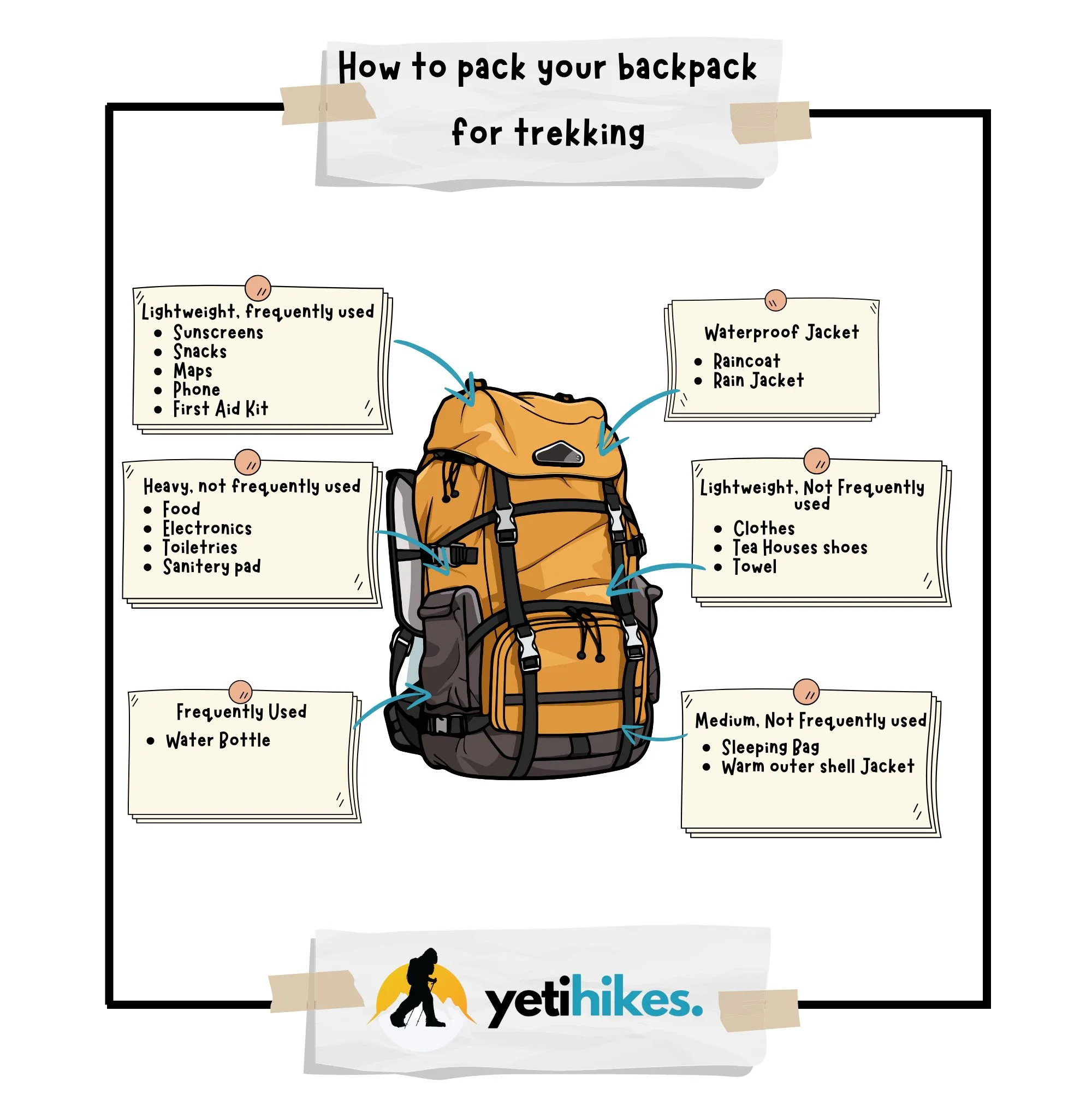
Backpack Packing & Gear Image
FAQs Of Annapurna Circuit Trek with Tilicho Lake- 15 days
Reviews & Testimonials Of Annapurna Circuit Trek with Tilicho Lake- 15 days
Nicole C
Alex M
Charlie P
یاشار ع
Lucy G
Sightsee64391744719
M B
Alex S
Nikesh K C
Lucy Gardiner
Abbie Blackledge
Alex Mackay
Hunter Parsons
Tal A
nikita k
Recommended Blogs
Annapurna Circuit trek itinerary and map breakdown
The Annapurna Circuit is known as one of the most popular treks routes in Nepal, offering a rich blend of ethnic heritage, stunning mountain scenery, and a diverse range of landscapes. The trek includes the spectacular views of the Annapurna Massif and has rich subtropical forests, alpine regions, as well as the legendary Thorong La Pass at 5,416 meters. The Annapurna Circuit Trek in Nepal has numerous pathways to suit your trekking experience and in this blog we will provide you a detailed itinerary and main breakdown of the three main variations: Annapurna Circuit Trek In the midst of the Himalayas, the Annapurna Circuit Trek is one of the iconic trekking routes in Nepal. The trek takes you through beautiful subtropical forests, terraced fields, and remote villages as you gradually climb up to the Thorong La Pass which is known as one of the highest trekking passes in the world. You will experience the breathtaking views of Annapurna, Dhaulagiri and Machapuchare as you pass through the traditional Tibetan and Gurung villages including the sacred sites like Muktinath and serene alpine lakes. The trek has challenging high altitude therefore, it is recommended to moderately experienced trekkers. The sunrise at Poonhill, natural hot springs at Tatopani and the cultural richness of Manang and Marpha adds a beautiful experience during the Annapurna Circuit Trek. Highlights of Annapurna Circuit Trek: Enjoy the scenic drive through rivers, terraced fields, and hillside villages as you trek through pine forests, waterfalls and Tibetan style villages. Experience the panoramic views of Annapurna, Lamjung and surrounding peaks from the Upper Pisang route leading into Manang. Explore Gangapurna Lake, Ice Lake, and cultural exploration in Manang during the acclimatization hike. Trek through the Kali Gandaki Valley, Kagbeni, and Jomsom and cross Thorong La Pass with the amazing Himalayan views. Relax in the natural hot spring at Tatopani and also enjoy the sunrise view over Annapurna and Dhaulagiri ranges from Poon Hill. Uncover the beautiful sacred pilgrimage site of Muktinath for both Hindus and Buddhists, nestled at the foot of the Thorong La Pass. Itinerary of Annapurna Circuit Trek Day 1: Drive from Kathmandu to Besisahar, then to DharapaniDay 2: Trek from Dharapani to ChameDay 3: Trek from Chame to PisangDay 4: Trek from Pisang to ManangDay 5: Acclimatization day in ManangDay 6: Trek from Manang to Yak KharkaDay 7: Trek from Yak Kharka to Thorong PhediDay 8: Cross Thorong La Pass, trek to MuktinathDay 9: Trek from Muktinath to MarphaDay 10: Trek from Marpha to KalopaniDay 11: Trek from Kalopani to TatopaniDay 12: Trek from Tatopani to GhorepaniDay 13: Hike to Poon Hill, trek to Nayapul, drive to PokharaDay 14: Drive or fly from Pokhara to Kathmandu Map of Annapurna Circuit Trek Annapurna Circuit Trek with Poonhill The Annapurna Circuit with Poon Hill Trek is considered one of the most legendary trekking routes in Nepal, incorporating the famous Annapurna Circuit trail with breathtaking sunrise views of the Himalayas at Poon Hill. This 14-day tour will lead you through the green valleys, alpine forests, typical Gurung and Thakali villages, and the difficult high-altitude route of Thorong La Pass (5,416 m). Spectacular mountains, such as Annapurna II, Gangapurna, and Tilicho Peak, will be all around you as you hike through some beautiful villages, including Chame, Upper Pisang, and Manang Valley. Manang has a special acclimatisation day that helps you adjust to the altitude and be ready to cross the highest point of the trek, Thorong La Pass. After passing through, the trail takes you to Muktinath, a holy pilgrimage site, followed by Tatopani, where you can enjoy the natural hot springs. The best part of the second half of the trek is the sunrise trek to Poon Hill (3,210 m), which offers panoramic views of the Annapurna and Dhaulagiri ranges. Highlights of Annapurna Circuit with PoonHill Trek: Pass through the mythical Thorong La Pass (5,416 m): One of the highest trekking passes in the world that provides a breathtaking view of the Himalayas. Enjoy the spectacular sunset at Poonhill (3,210 m): A panoramic view of Annapurna, Dhaulagiri, Machhapuchhre, and Nilgiri in golden colour. Visit Manang Valley (3,519 m): A culturally rich Tibetan-inspired village, which is surrounded by dramatic scenery and glaciers. Tatopani Natural Hot Springs: The natural hot springs are ideal for relaxing tired muscles after a day of trekking. Explore the holy temple of Muktinath: A religious centre of worship for both Hindus and Buddhists. Hike across a variety of terrain: Subtropical forests, rice terraces, high alpine deserts and glacial valleys. Have a rich cultural experience: Enjoy local hospitality in the Gurung, Thakali, and Tibetan communities and visit local tea houses. Itinerary of Annapurna Circuit with PoonHill Trek Day 1: Arrival in Kathmandu and Transfer to hotelDay 2: Drive to Dharapani via BesisaharDay 3: Trek to ChameDay 4: Trek to Upper PisangDay 5: Trek to Manang ValleyDay 6: Acclimatization day at ManangDay 7: Trek to Yak KharkaDay 8: Trek to Thorang High CampDay 9: Cross Thorang La and MuktinathDay 10: Drive from Muktinath to TatopaniDay 11: Trek to GhorepaniDay 12: Hike Poon Hill and trek back to UlleriDay 13: Drive or Fly back to KathmanduDay 14: International Departure Map of Annapurna Circuit trek with Poonhill Annapurna Circuit with Tilicho Lake Trek The Annapurna Circuit Trek with Tilicho Lake is a 15-day mythical Himalayan tour in the Annapurna Region. It is the longer version of the Annapurna Circuit, in which you will undertake an exciting and legendary trekking trail to Tilicho Lake (4,919 m), one of the highest glacial lakes in the world. The trek offers an enriched experience of high-altitude adventure, spectacular mountain views, and extensive cultural immersion in the Annapurna Region, Nepal. The Tilicho Lake side trip is a challenge, but also a reward for your Annapurna Circuit trek. At Tilicho Lake, you will be able to take in the beautiful sight of snow-capped peaks and glacial moraines, including Tilicho Peak, Annapurna II, III, IV, and Gangapurna. Having reached the lake, the path rejoins the circuit trek and proceeds to the spectacular Thorong La Pass (5,416 m). It is one of the best and rewarding trekking experience in the Himalayas. Whether you want adventure, spiritual enlightenment or natural beauty, the Annapurna Circuit Trek with Tilicho Lake has it all. The trek offers a diverse range of landscapes, cultures, and experiences, complemented by a moderate level of physical adventure. Highlights of Annapurna Circuit with Tilicho Lake Trek: The Annapurna Circuit Trek is a legendary long-distance trek in the world, featuring a spectacular change in elevation between subtropical valleys and high alpine passes. In the course of the trek to Annapurna Circuit, you will also visit Tilicho Lake that is regarded as one of the highest lakes in the world. It is a wild and rough beauty with the breathtaking views of Tilicho Peak and glaciers around. Thorong La Pass at 5,416m is the highest point of Annapurna Trek and the views of Annapurna and Dhaulagiri ranges are spectacular. The beauty of Annapurna Region is the diversity of the landscapes, abundance of rice terraces, pine forests, rocky cliffs, and alpine deserts as well as the Tibetan Buddhist culture in such villages as Manang and Pisang. Visit monasteries, chortens and prayer wheels along the trail and also visit the sacred Muktinath Temple situated at lower Mustang which is significant among both Hindus and Buddhists. The villages of Siri Kharka, Yak Kharka, and Tilicho Base Camp have the original Himalayan culture in which you can interact with Gurung, Thakali, and Manangi people. Itinerary of Annapurna Circuit with Tilicho Lake Trek Day 1: Drive from Kathmandu to JagatDay 2: Trek from Jagat to DharapaniDay 3: Trek from Dharapani to ChameDay 4: Trek from Chame to PisangDay 5: Trek from Pisang to ManangDay 6: Acclimatization day in ManangDay 7: Trek from Manang to Siri KharkaDay 8: Trek from Siri Kharka to Tilicho Base CampDay 9: Early morning hike to Tilicho Lake and return to Siri KharkaDay 10: Trek from Siri Kharka to Yak KharkaDay 11: Trek from Yak Kharka to Thorong PhediDay 12: Cross Thorong La Pass and trek to MuktinathDay 13: Trek or drive to JomsomDay 14: Morning flight from Jomsom to PokharaDay 15: Drive or fly back to Kathmandu Map of Annapurna Circuit with Tilicho Lake Trek Short Annapurna Circuit Trek In the Annapurna Region, the Short Annapurna Circuit Trek in the mountain ranges of central Nepal is the ideal place where you can get to experience the natural beauty of Nepal. Crossing the beautiful and frozen mountains of the Himalayan range, you will have a feeling of heavenly views along with natural hot springs. The mountains are covered with snow like Annapurna I and II, Gangapurna, and Pisang Peak, which are encircled by rhododendron forests and Gurung villages, which are a view you should see at least once in your life. To have a fulfilling culture experience, mingle with the locals and learn their everyday way of life. Trace the Marsyangdi River and enjoy the waterfalls and cliffs around and be awed by the Gangapurna Glacier, including the beautiful Manang Emerald Lake. Use your time to absorb the amazing landscape as you get to know more about the traditional Tibetan architecture. Arrive at Thorong High Camp and pass the longest Thorong La Pass (5,416 m) in the world and feel the excitement of being at the highest point of this trek. It is a journey that combines nature and culture in one adventure. Highlights of Short Annapurna Circuit Trek: Pass through the Iconic Thorong La Pass (5,416 m): Feel the excitement of crossing one of the highest trekking passes in the world with a spectacular view of Annapurna, Dhaulagiri and Manaslu ranges. Scenic Drive and Trek Along Marsyangdi River Valley: Follow beautiful river valleys, tumbling waterfalls, and beautiful villages as you observe dramatic sceneries. Visit Manang and Gangapurna Glacier: Visit the emerald-green Manang Lake and be near the Gangapurna Glacier. Cultural Interactions with Gurung and Thakali Communities: Get to know the rich culture, Tibetan style buildings and the friendly nature of the locals. Natural Hot Springs at Tatopani: Relax your body and refresh in the well-known natural hot water springs. Himalayan Panoramas that are Stunning: Take in the panoramas of Annapurna I & II, Gangapurna, Pisang Peak, and the snow-capped giants around. Itinerary of Short Annapurna Circuit Trek Day 1: Drive to Dharapani via BesisaharDay 2: Trek to ChameDay 3: Tek to PisangDay 4: Trek to Manang ValleyDay 5: Acclimatization at Manang ValleyDay 6: Trek to Yak KharkaDay 7: Trek to Thorong HIgh CampDay 8: Cross Throng La and MuktinathDay 9: Drive from Muktinath to TatopaniDay 10: Drive or flight back to Pokhara Map of Short Annapurna Circuit Trek Which Annapurna Circuit Route Should You Choose? Beside the standard Annapurna Circuit Trek Route, you can choose other variations of the trek based on your preference of trekking days and other criteria. With the help of the following table you can option for the route that suits you the best! Route Duration Best For Key Highlights Ideal For Short Annapurna Circuit 10 Days Trekkers with limited time. Thorong La Pass (5,416 m), Manang Valley, Tatopani hot springs. Beginners with good fitness or those on tight schedules. Annapurna Circuit and Poon Hill Trek 14 Days Cultural lovers and sunrise chasers. Thorong La Pass, Poon Hill sunrise (3,210 m), Gurung and Thakali villages. Moderate trekkers wanting both high passes & cultural trails. Annapurna Circuit Trek and Tilicho Lake 15 Days Adventure seekers and experienced trekkers. Tilicho Lake (4,919 m), Thorong La Pass, less crowded trails. Experienced trekkers seeking unique high altitude experiences. Annapurna Circuit vs Annapurna Base Camp: Which Trek is Right for You? The Annapurna Base Camp (ABC) Trek is another popular option in the Annapurna region, in addition to the Annapurna Circuit Trek (ACT). Although ABC will bring you to the foot of Annapurna I (8,091 m) and an impressive amphitheatre of mountains, it is a shorter trek and the route is less complicated. Conversely, ACT provides a full 360 degree experience of the Annapurna range with a mixture of cultural experiences, varying landscapes and the exhilarating adventure of crossing the Thorong La Pass (5,416 m). To trekkers who want a more diverse experience, ACT is usually seen to be better, because it has a rich cultural experience, a lot of variety in scenery, and is longer hence you can actually have a feel of the core of the Himalayas. Although ABC is ideal to those trekkers who have little time and desire to get intimate views of the mountains, the Annapurna Circuit offers a more inclusive trekking experience in the Annapurna region of Nepal. Your Trusted Partner: Yeti Hikes If you intend to do the Annapurna Circuit Trek or any of its popular variations, Yeti Hikes is here for you to ensure a safe and enjoyable trip. We have professional guides, organized itineraries and are very serious about responsible tourism. No matter which of the popular Annapurna Circuit, the Tilicho Lake extension, or the sunrise on Poon Hill you want to cover, Yeti Hikes offers tailored services so that trekkers of any experience level can get the most out of their time in the Himalayas. Why Should the Annapurna Circuit Trek Be on Your Bucket List? The Annapurna Circuit Trek is a unique combination of the most spectacular natural beauty. It has a wide range of culture and thrilling adventure including the lush subtropical forests and the legendary Thorong La Pass at 5,400 meters. The range of Annapurna Circuit suits everyone, from experienced hikers to dedicated beginners. Whether the standard Nepal Annapurna Trek itinerary or Tilicho Lake Trek, Poon Hill Trek, you can choose which is best for you. It is a life changing experience and should be on every traveller’s bucket list because of its mesmerizing mountain view as well as friendly local communities of Nepal.
Why to take guide and porter during the trek to Nepal?
Introduction While traveling to Nepal, adventurers like you will discover remarkable natural views and distinct social traditions, which can be slightly challenging. A new place and journey where you want to achieve your travel goals can be fulfilled as you hire guidance and portering support. A significant question of why you take a guide and porter during the trek to Nepal answers your query with an enhanced pillar during your trekking experience. Guides and porters, the local support significantly benefits your travel, including safety prevention, convenience, cultural opportunities, and background. Working with us, Yeti Hikes will enhance your experience through our professional expertise and responsible service delivery. We, the team of Yeti Hikes, provide professional guidance, experienced portering services, and dedicated support for Nepalese communities throughout the trekking experience. We also offer individualized tour packages combined with specialized guidance and flawless operational support for flawless trekking expertise dedicated to the natural wonders of Nepal. Why are guides and porters essential during the trek to Nepal? Ensuring Safety and Navigation Nepal's expedition paths exhibit irregular conditions, especially those in distant regions, including Everest, Annapurna, and Langtang. The presence of a licensed guide ensures your safety because they handle extreme terrain while reading weather changes and handling emergencies. The trekking risks of altitude sickness, sudden weather conditions, and unforeseen accidents often escape the understanding of inexperienced trekkers. Guides receive instruction in first aid services and training in altitude sickness care and emergency preparedness to protect trekkers from start to finish. The knowledge possessed by a guide helps eliminate the risk of becoming lost because they understand all pathways and know the entire local environment. Cultural Insights and Local Knowledge A trekking guide provides more than a trial direction because it links you to Nepal's deep historical past and cultural heritage. Guides break communication limits by making it possible to engage with people and learn about local customs, leading you to recognize the essential significance of holy shrines, traditional observances, and everyday life practices. A trekking guide creates better opportunities to dive deep into local culture, generating enhanced significance and enrichment during your journey. With a guide, you achieve more authentic experiences because they help you connect with Buddhist monasteries across Nepal along with local traditions and enable conversations with people who live in nearby villages. Convenience and Physical Relief Traveling by foot across the Nepalese terrain demands transporting necessary gear provisions and other essentials through difficult mountain paths. Climbing with an overweight backpack at high altitudes creates extreme physical strain and total exhaustion during multiple days. The employment of a porter frees you to experience the journey with ease because they remove your physical burden. The Everest Base Camp and the Annapurna Circuit benefit tremendously from porter assistance due to the altitude challenges that increase the apparent weight of even lightweight loads. Your porter will carry your luggage so you can enjoy the view and take pictures without exhausting yourself before the rest of the trek. Porters' professional experience enables them to transport mountainous weights in challenging altitude environments. Using porter services generates employment opportunities within local communities, so members of these communities experience advantages from tourism employment. However, you should guarantee that their porters receive good treatment, have adequate equipment, and earn reasonable payments. Supporting the Local Economy Economic support flows from local communities because employers hire guides and porters directly. Trekking tourism provides income that sustains many Nepali families, so choosing local staff members is vital to sustainable tourism. At Yeti Hikes, we guarantee ethical pay standards and proper treatment of their guide staff and porters, optimizing responsible trekking experiences. Your choice to hire staff from the local area ensures personal satisfaction and supports the regional economic growth of Nepal's rural parts. Employing guides and porters during trekking operations helps keep mountain lodges and other trekking route services in operation. Trekkers depend on numerous small businesses for survival while hiring local staff helps build the economy of distant areas. Emergency Assistance and Problem-Solving Guides handle unexpected trek occurrences involving swift weather conditions, fitness problems, or permit-related authorization problems. The guides know how to manage challenging situations through evacuation preparations while securing medical care for their clients. The staff members demonstrate practical problem-solving abilities that convert troublesome problems into enacted solutions so trekkers can maintain a more enjoyable journey. During high-altitude treks, the common issue of altitude sickness requires expert recognition by guides who will take essential preventive measures. At the same time, guides possess expertise in following evacuation protocols and know where to find emergency communication systems. Professionals accompanying you on the trip allow you to relax and enjoy your trek because they provide safety assurance. Access to Better Accommodation and Food Trekking routes throughout Nepal contain many teahouses and lodges, yet finding reasonable accommodations becomes hard during peak tourist periods. By establishing connections with teahouse owners, guides ensure clients can access the most comfortable and nutritious lodging options. When working with a guide, they will recommend clean, healthy food options that suit trekking requirements. Understanding Permits and Regulations In every trekking situation, guides maintain proper documentation by handling TIMS (Trekkers' Information Management System) cards, national park permits, and restricted area permits. Licensed guides must explore the Upper Mustang and Kanchenjunga trekking regions since these destinations are in isolated, restricted areas. Partnering with a guide guarantees compliance with local laws and protection against legal issues on your trek. Enjoying a More Relaxed Trekking Experience Trekking through Nepal involves more than destination achievement because it grants you the complete trip experience. Hiring a guide and porter lets you minimize your physical strain and improve safety conditions while providing cultural learning that enables you to experience the expedition entirely. Leaving logistics, permits, and route search responsibilities behind you gives you the freedom to savor the scenery and experiences Nepal delivers. Guides' Recommendations and Your Responsibilities Expert trekking guides recommend researching trails, fitness prep, and packing essentials (water, maps, first-aid). Prioritize safety: check weather, inform others of routes, and hire certified guides for challenging terrains. Your responsibilities include respecting nature, avoid littering, stay on marked paths, and follow local guidelines. Minimize ecological impact by carrying waste back, avoiding wildlife disruption, and supporting sustainable tourism. Adhere to group safety protocols, communicate health concerns, and carry permits if required. Responsible trekking preserves ecosystems and ensures adventurer safety. Balance adventure with mindfulness, prioritize preparedness, environmental stewardship, and cultural respect for a sustainable trekking experience. Pacing and Itinerary Adjustments Yeti Hikes provides you with guides and professional advice, so their recommendations should always be trusted. When guides recommend resting or selecting new paths, you must always prioritize safety and comfort for the trekkers. Your itineraries must be flexible enough to include such suggestions. Acclimatization Your trekking packages require client education about proper acclimatization procedures. Your travel schedule must include appropriate rest periods to decrease the chance of altitude sickness. Health and Safety Precautions Depending on weather conditions and the group's health profile, the guide recommends bringing altitude and sickness medicine, sunscreen, and additional water supplies to a hike. Porter's Role and Importance Trekking porters are vital for high-altitude expeditions, managing gear transport, camp setup, and route navigation. Their physical endurance and local expertise ensure trekker safety, allowing adventurers to focus on the experience. Porters reduce logistical burdens, enabling access to remote trails while supporting local economies. Their role promotes sustainable tourism by bridging cultural gaps and ensuring ethical practices. Recognizing their contributions fosters fair treatment and enhances trek success. Essential in challenging terrains, porters are unsung heroes, blending resilience with invaluable trail knowledge for unforgettable journeys. Prioritize porter welfare to uphold responsible trekking ethics. Logistical Support and Safety Travelers can experience hiking without burdensome load weight because porters deliver fundamental equipment and supplies, thus providing trekkers with physical freedom. Their tasks include helping to find the proper routes when the territory becomes hard to traverse and offering emergency response capabilities. Economic and Cultural Impact The local economy benefits significantly from Porters, who mainly originate from rural areas. The regional economy grows because porters generate income that keeps families afloat and stimulates economic development. Access to local cultural insight and a complete trekking experience that porters create represent one of their primary values. Ethical and Fair Treatment The payment of porters must be fair, appropriate equipment must be provided, and respect must be shown to maintain ethical standards. A sustainable trekking experience benefits both the porters and trekkers through proper ethical treatment, fair pay, and intended safety provisions. Personal Testimonials with Yeti Hikes' Guide and Porter Nikita K ⭐⭐⭐⭐⭐ I had an incredible experience trekking the Annapurna Circuit, and much of it was thanks to my fantastic guide, Amir. The diverse landscapes of the Annapurna region were absolutely stunning, and Amir's expertise made the entire journey seamless and enjoyable. His deep knowledge of the region, attention to detail, and dedication to my safety and comfort were remarkable. From sharing fascinating insights about the culture and geography to ensuring every part of the trek went smoothly, Amir truly went above and beyond. I highly recommend him to anyone planning to explore the Annapurna Circuit or other nearby areas! Harry Samuels ⭐⭐⭐⭐⭐ Brilliant experience with Yeti Hikes My brother and I did the Manaslu Circuit and crossed Larke Pass (5106m) this month with Yeti Hikes. Dipak arranged the passes and our guide in advance of us arriving, so everything was in place when we landed in Kathmandu. Having trekked in Nepal previously, but without a guide/organiser, this was much easier than trying to organise passes ourselves. This was necessary as we only had a limited time off work, and having to organise the passes ourselves would have eaten into this time.This is the second time we’ve had help from Dipak, and he organised everything perfectly on both occasions.Prem, our guide, was absolutely brilliant. He was perfectly attentive throughout the trek, and consistently booked the better quality teahouses in each location. Prem is also native to the Manaslu region, so his knowledge of the area was brilliant. We had a good laugh during the two weeks trekking, too.We had a great time trekking, and will definitely use Yeti Hikes when we next return to Nepal for a guided trek. Breakdown of Trekking Cost (With or Without Guides and Porters) Expense Category Cost Without Guide & Porter Cost With Guide & Porter Permit Fees $20 - $50 $20 - $50 Accommodation $5 - $30 per night $5 - $30 per night Meals $3 - $10 per meal $3 - $10 per meal Transportation to Trailhead $10 - $150 $10 - $150 Equipment & Gear $100 - $500+ $100 - $500+ Miscellaneous Costs (Water, Snacks, Extras) $5 - $20 per day $5 - $20 per day Guide Fees N/A $20 - $40 per day Porter Fees N/A $15 - $25 per day Total Estimated Cost (Low End) $300 - $500 $600 - $1,000 Total Estimated Cost (High End) $800+ $1,200+ Packing Tips and Gear Recommendations Preparing for a trek through Nepal requires proper equipment planning to achieve comfortable and secure travel conditions. You need essential clothing, as layering provides the best strategy to meet changing weather patterns affecting mountain regions. To face any conditions properly, a moisture-wicking base layer followed by fleece for insulation is first needed and topped with a durable waterproof cover. Trekking boots in good condition with glove-and-hat-compatible warm socks and a waterproof outer layer should be on your packing list for trekking in Nepal when temperatures drop. One must buy a suitable sleeping bag designed to function in cold temperatures for higher mountain areas while bringing headlamp equipment, including extra batteries for nighttime usage. You need a daypack, a water bottle or hydration system, and trekking poles to assist your trek. Your luggage should be minimal but contain every essential item required for upcoming climate conditions you will encounter. As part of their services, Yeti Hikes lets guests rent trekking equipment, which provides high-quality gear rental options when customers arrive. The journey will be enhanced by packing a small first aid kit, sunscreen, lip balm, and a camera for photographing amazing views. Remote trekking requires hand sanitizer, wet wipes, and a water purification system or tablets for personal use. The essential trekking authorizations and documents must be in your possession. The appropriate preparation will make your journey more pleasant so you can tackle the terrain differences of Nepal effectively. A Day in the Life of a Trekking Guide and Porter in Nepal Trekking guides and porters in Nepal start their daily duties before daybreak during each new morning. The guide begins each morning by reviewing the planned route while checking weather forecasts and confirming that trekkers have sufficient preparation for daily activities. When the trekking journey starts, the guide takes the lead position while sharing local cultural and historical context. These guides conduct the pace assessment to permit safe altitude adjustment while planning proper rest stops. The porter must carry weights throughout the day, including trekking equipment, supplies, and food across challenging mountain paths. These workers begin their work before the trekkers bring their luggage to the next resting place before the trekkers arrive. Guides and porters cope with significant physical difficulties throughout their daily work duties. Guides continuously observe group members' health to identify signs of altitude sickness, dehydration, and exhaustion in the team. Portable medical knowledge and evacuation preparation are essential skills that guides have because they need to help people in case of injuries and emergencies. While carrying loads that exceed their body weight, porters often move forward on mountain trails with steep elevations and rocky surfaces. The physical exertion from carrying heavy loads does not deter porters from establishing friendly conversations with their trekking groups since they maintain a constant movement pattern. After arriving at the next destination, the escort ensures the group members feel at ease by organizing lodging and dining arrangements so the porter can rest before tomorrow's strenuous activity. The guide and porter finish their work day satisfied because both understand that their efforts make every trekking experience memorable and secure for their clients. Tipping Tips for Guides and Porters Guiding services should receive 15% to 20% of tips package cost, while porters get between 8% and 10%. The tipping sums depend on the severity of the trek, the quality of guides and porters, and the trek's actual duration. Numerous trekkers select tip-sharing pooling during their trek to distribute the money fairly. Tipping is suggested according to service quality, the length of your trek, and the number of crew members involved. As a trekking agency, Yeti Hikes suggests you show gratitude to their Nepalese travel guides and porters by tipping them for their persistent commitment. Guides and porters lacking banking access in remote areas should receive cash tips since banking is unavailable. Experience demonstrates that tipping should be done in person to express genuine appreciation for their efforts. Trekkers usually provide tips toward the end of their journey, during which their group completes the trek. Keeping cultural principles in mind while offering tips that match the received services creates positive relationships between trekkers and crew members. Why travel with Yeti Hikes guide? As a travel partner, Yeti Hikes provides trekkers with special sustainability-focused excursion packages at affordable costs while maintaining exceptional standards. Yeti Hikes presents diverse trekking packages with expert selection, which offers multiple pricing options for every budget type. We set transparent pricing, covering necessary items, including trailhead transportation, permits, accommodations and meals, and standard permits. Our services adapt to your choices between guide-assisted trekking options and self-guided journeys to provide untroubled experiences. Your trekking experience in Annapurna Base Camp will benefit from guides and porters who provide helpful local knowledge and practical assistance and guarantee constant care and protection for your safety. The expenses for guide services and porter assistance remain affordable, and our team takes responsibility for delivering appropriate payments that provide financial benefits to local communities. The team at Yeti Hikes recognizes that experienced and proficient guides combine technical trekking expertise with thorough knowledge of Nepalese cultural heritage. The guides possess first aid capabilities and thorough course knowledge to deliver a protected, educational trekking experience. Your trek becomes less strenuous since our porters transport all your heavy equipment, allowing you to enjoy the journey without physical exhaustion. Our package prices include guide and porter expenses and our dedication to treating both groups with dignity. Conclusion: Fun Travel with Support Yeti Hikes delivers expert guide services with porter assistance and arranges trips to Everest Base Camp, Annapurna, Langtang, and more destinations. Traveling alone on a trek should be avoided in favor of having a skilled guide accompany you. Experience Nepal to the fullest through us. Yeti Hikes experts, our cultural expertise, and our logistical network will create an unforgettable trekking experience in Nepal.
Best Season to Trek in Nepal
Introduction A trekking adventure through Nepal brings combined exploration experiences and traditional cultural immersion regardless of the season. However, based on different factors, the best seasons to trek in Nepal are Spring (March-May) and Autumn (September-November). These seasons offer complete weather clarity, moderate climate conditions, and spectacular scenery. The existing trekking routes, such as Everest Base Camp, Annapurna Circuit and Langtang Valley, offer their best conditions during Autumn and spring when visitors can experience refreshing mountain air amid colourful mountain views. During Autumn, the skies remain clear after the rainy season, thus delivering stunning views of the mountains together with great weather for trekking. In contrast, spring brings bright rhododendron flowers and flowing waterfalls with species-rich wildlife during each trekking stage. The journey we designed, Yeti Hikes, enables travellers to experience Nepal's natural wonders irrespective of their choice between autumn mountain views, spring blooming trails, snowy landscapes in winter, or monsoon greenery. Our experienced guides, carefully crafted trips, and complete knowledge of Nepal combine to transform every season into a perfect trekking opportunity for their clients. Yeti Hikes delivers experiences that combine beneficial cultural tours with exciting high-altitude adventures for its clients. Trekking in Spring: A Colorful Journey Spring railways across Nepal experience a remarkable transformation, making it the most favourable period for travellers. The combination of clear skies and pleasant temperatures, which nature creates by covering all regions with green vegetation, sets a perfect habitat for trekking adventures involving natural awe and cultural discovery. Nepal displays its stunning trekking locations during spring because the season brings out the colourful blooms of rhododendrons and scenic mountain panoramas. Nepal welcomes every adventurer during spring because its trekking experiences suit all interests, from wildlife exploration to cultural festivals and panoramic landscapes. Scenery: A Colorful Himalayan Wonderland During the spring season, the trekking paths of Nepal reveal themselves as spectacular beauty through their vibrant forest vegetation, charming rhododendron blooms and intense Himalayan peak vistas against brilliant blue skies. When snow melts from last winter, the hills and valleys become spectacular through shades of red, pink and white rhododendron flowering, making this trekking experience truly beautiful. Spring viewers find extraordinary fame in Ghorepani Poon Hill and Langtang Valley and Mardi Himal trails because their colourful wildflowers create an incredible show of beauty at each trail step. The combination of snow peaks with colourful green hills offers spring trekking to explorers and travellers an unmatchable visual adventure. The Himalayan mountains deliver clear panoramas for the entire season and become most stunning in the early mornings and late afternoons. Warmer months create extraordinary opportunities for visitors to experience Everest Base Camp alongside Annapurna Base Camp and Manaslu Circuit since it reveals pure and seamless views of Everest and Annapurna with Dhaulagiri and various other magnificent peaks. The rivers and waterfalls that run due to snowmelt create yet another picturesque element in the landscapes. The spring season provides hikers with complete harmony between scenic natural landscapes and dramatic views of mountains when they pass through alpine regions together with forests. Trail Conditions: Stable Weather and Comfortable Trekking The region of Nepal provides perfect trail conditions during springtime because hot temperatures remain moderate throughout this season, making it easy to walk the terrain. Mountain elevation determines the weather conditions, so lower areas experience temperatures between 10–20°C while higher areas maintain freezing temperatures between -5 and 5°C. The dissolving snow from winter enables mountaineers to access climbing destinations like Everest Base Camp and Annapurna Circuit during this period when harsh winter cold is no longer present. During springtime, the trails remain dry and safe, creating optimal conditions for novice and professional walkers to enjoy their trekking experience. Long spring daytime hours provide trekkers additional time to advance through their journeys without worrying about speed. During spring, the weather pattern shows fewer surprises than summer storms and harsh winter conditions, which lets trekkers schedule their trips easily. During this period, the most well-known trekking areas, for example, Everest and Annapurna, experienced increased visitor activity because spring remains a peak season for trekking. Nepal's Himalayas shine the brightest during spring due to calm weather conditions and stunning landscapes, which bring out the region's spectacular beauty despite the high number of visitors. Wildlife: A Season of Life and Activity The spring season in Nepal offers both fields of beautiful flowers and mountain vistas and an excellent opportunity to observe Nepal's variety of wildlife. When snow starts melting and temperature increases, animals that stay hidden come out of their winter residences. Trekkers exploring the Langtang, Manaslu and Annapurna regions can spot Himalayan monals with blue sheep, red pandas, and langurs. Wandering bird enthusiasts will delight in the warm spring season because numerous migratory birds arrive to produce melodious sounds across the hiking paths. The abundant natural resources from spring vegetation create excellent feeding conditions, which makes wildlife more active and noticeable to trekkers searching for wildlife. Visitors who venture into distant areas such as Upper Mustang or Dolpo have the once-in-a-lifetime opportunity to encounter the enigmatic snow leopard because these creatures move down from their high-altitude habitat to feed before summertime. During the spring, numerous Himalayan animals become active for mating purposes, enabling trekkers to spot newborn tahrs and deer and pheasant chicks from the trails. Spring trekking allows people to fully engage with natural surroundings through its active wildlife, beautiful plants, and breathtaking mountain scenery. Festivals: Cultural Celebrations Along the Trails During Nepalese spring, customary celebrations add excitement to the natural environment. The highly famous springtime celebration Holi (the Festival of Colors) occurs in March to welcome the season change. During celebrations in Kathmandu, Pokhara, and other significant towns, Nepalese people participate in pleasant rituals using coloured powders and water for traditional festivities. Before starting their mountain treks from Kathmandu or Pokhara, the trekkers can partake in the energetic Holi festival. The celebration of Buddha Jayanti finds its place in April or May to honour the significant events in the life of Lord Buddha, including his birth, enlightenment, and death. People from Buddhist parts of Everest, Langtang and Manang participate in specific religious events, including monastic prayers,ter lamp rituals and spiritual meetings. Buddhist devotees can observe unique religious ceremonies deep within the Himalayas during these festivals. Trekking to the Everest region offers visitors both the natural beauty and cultural depth of Tengboche Monastery, while the Manaslu expedition during Buddha Jayanti allows exploration of Lho Monastery. Yeti Hikes: The Perfect Time for an Unforgettable Adventure Spring is the top season for trekking in Nepal at Yeti Hikes because it provides ideal weather, spectacular views, and deep cultural exploration. With experienced guides from Yeti Hikes, you will achieve maximum satisfaction on your trek throughout the Annapurna's rhododendron forest blooms Everest's high altitudes and Manaslu and Mustang's secluded trails. Yeti Hikes will modify your trekking experience by adding local festivals and cultural interactions to enhance your overall journey. Yeti Hikes creates Himalayan journeys for novice trekkers pursuing beautiful escapades along with veteran trekkers who want to demand high-altitude excursions. Yeti Hikes leads travellers to discover the best parts of Nepal during spring through their expert guidance backed by deep local knowledge that creates perfect adventures across natural landscapes. Grab your travel gear, and Yeti Hikes will provide an unforgettable, long-term springtime exploration. Trekking in Autumn: A Breathtaking Adventure Nepal establishes itself as the most favourable trekking period between September and November. Autumn brings brilliance through its comprehensible skies and cool temperatures alongside soft air, providing ideal conditions to enjoy the trekking trails while experiencing Nepalese culture at its peak. Autumn presents trekkers with the perfect moment to experience Nepal's captivating landscapes blended with its cultural festivities, breathtaking mountain views, and colourful autumn foliage. The following section provides detailed information about autumn trekking in Nepal. Scenery: A Panoramic Dreamscape The Autumn season in Nepal offers viewers the most extraordinary views of mountains that stretch into crystalline perfection. A clear atmosphere above the trekking areas shows trekkers the mountain giants, Everest, Annapurna, and Machhapuchhre. After monsoon winds pass, the atmospheric condition becomes better, thus allowing trekkers to see the Himalayas in all directions. Nature transforms its forest and hills into vibrant autumn colours by combining high mountain tops with snow and brightly coloured leaves with green meadows. Hikers will face no weather discomforts during their trek since the mild temperatures enable them to visit high-altitude passes and lower-altitude forested areas. The dramatic mountain terrains create colourful lighting displays when sunset or sunrise occurs in Autumn. Trail Conditions: Comfortable and Stable Weather The autumn season presents Nepal with its finest trekking environment. Trekking becomes optimal because the climatic conditions remain balanced while temperature levels stay moderate. Weekday temperatures in lower regions rest between 10°C and 20°C, and mountain regions maintain temperatures between -5°C and 5°C. The trekking routes are in excellent condition, thus offering dry surfaces that reduce risks and provide convenient pathways for visitors. The climate remains agreeable throughout the year because trekkers do not need to face summer heat or winter frost. The extended period of daylight enables hikers to extend their time spent exploring trails. The autumn weather ensures stable conditions on all trekking paths, including the Annapurna Circuit, Everest Base Camp, and Langtang Valley, providing visitors with a smooth, effortless trekking experience. Wildlife: A Thriving Ecosystem During Autumn, the trekking routes welcome active wildlife to their paths. Many plant and animal organisms thrive throughout the lower forested areas. The Himalayan monal, together with monkeys and wild boars, appear most frequently this season when residents register sightings of multiple bird species and various wildlife groups across Nepal. Visitors can spot the rare red panda and snow leopard sightings in remote mountain areas of higher elevations. The autumn season is ideal for observing migratory birds that travel through Nepal, elevating the biodiversity count in the region. During this season, the forest's oak and rhododendron trees tower above the ground, and numerous animals benefit from the abundant food, leading to increased visibility of wildlife in the region. Festivals: Vibrant Cultural Celebrations Autumn enhances the beauty of trekking in Nepal. The largest celebration among Nepalese Hindus is Dashain, which unfolds between September and October. The mountains will show trekkers the active participation of local communities as they conduct religious ceremonies, offer sacrifices, and organize family events. Villages become radiant during Tihar, the Festival of Lights, which uses oil lamps and candles in October and November. During the celebration of Tihar, local people living in both the Kathmandu Valley and the rural mountain areas demonstrate Nepali culture to trekkers. During Lama and Lama Chhe Buddhist celebrations in the Everest and Langtang regions, trekkers can witness Nepal's deep spiritual traditions. Yeti Hikes Take: Perfect Autumn Adventure According to Yeti Hikes, Autumn provides the right conditions for Nepal trekking adventures. Our expert guidelines will provide comfort and security through the best trekking paths while optimising trekking conditions. Autumn creates the best trekking conditions during such adventures as the Everest Base Camp or Annapurna Base Camp trek and the Langtang Valley Trek because it provides superior visibility and the most comfortable trekking environment. The carefully designed trekking plans at Yeti Hikes let guests discover extraordinary natural vistas, wildlife sightings, and cultural celebrations, highlighting the stunning essence of Nepal's autumn experiences. Yeti Hikes customised itineraries with two primary options for travellers who want physical tests or picturesque touring. Get ready for a breathtaking trekking adventure to marvel at the spectacular Himalayas throughout this beautiful Autumn. Best Trek Destinations in Nepal During Spring and Autumn Everest Base Camp Trek Everest Base Camp Trek is the most spectacular Himalayan journey because it reveals stunning sights of Mount Everest and adjacent peaks. Trekking in spring and Autumn provides ideal conditions with perfect weather and exceptional mountain scenery. The route leads travellers through Sherpa settlements, Buddhist temples, and the areas encompassed by Sagarmatha National Park. Highlights: Clear views of Everest, Ama Dablam, Lhotse, and Nuptse. Cultural insights into Sherpa villages and Tengboche Monastery. The trekking conditions are perfect during temperate weather because of moderate temperatures. Annapurna Circuit Trek Tourists interested in the Annapurna Circuit Trek will be captivated by its diverse landscapes because its path takes you through subtropical forests and Tibetan plateaus. Guests visiting during the spring or autumn seasons of this trek encounter the best conditions because they can experience vibrant rhododendron blooms and admire breathtaking vistas of the Annapurna Massif and Machhapuchhre. Thorong La Pass stands out as the highlight of the trek because it enables you to cross a high-altitude mountain pass. During the experience, you will also visit remote villages. Highlights: Panoramic views of the Annapurna Range, Dhaulagiri, and Machhapuchhre. Cultural experiences in Gurung and Tibetan villages. The thrill of crossing Thorong La Pass at 5,416 meters. Ghorepani Poon Hill Trek People who desire Himalayan mountain sightseeing despite having limited time should consider the Ghorepani Poon Hill Trek. Anyone who experiences sunrise views from Poon Hill toward the Annapurna Range will love this particular trek because it lets people see rhododendron forest colours every spring. Rhododendrons create a stunning visual treat during this period. The trek is an excellent choice for fresh or brief mountain travellers. Highlights: The combination of Annapurna and Dhaulagiri mountains can be observed during sunrise from Poon Hill. Travellers walk through areas filled with rhododendron plants and visit attractive rural settlements. It is a short and manageable trek suitable for all levels. Langtang Valley Trek Explore the peaceful Langtang Valley Trek if you want quiet landscapes and minimal crowds. You will see magnificent vistas of Langtang Lirung along with Ganesh Himal and Dorje Lakpa. The trekking conditions are ideal during springtime and Autumn when skies remain clear,and temperatures stay within moderate ranges. During this trek, one can explore the Tamang village culture while visiting the serene Kyanjin Gompa. Highlights: The trek offers panoramic perspectives of Langtang Lirung together with adjacent mountain peaks. A cultural immersion in Tamang villages and Tibetan Buddhist monasteries. The trekking period provides ideal conditions because the weather remains clear with comfortable temperatures. Manaslu Circuit Trek The Manaslu Circuit Trek promotes its status as an unvisited hiking route that delivers outstanding sightlines of Mount Manaslu while showcasing its position as the world's eighth tallest peak. The Manaslu Circuit Trek provides peak travelling conditions between spring and Autumn since both seasons offer a pleasant and dry walking environment. This trail provides memorable adventures because it shows travellers various landscapes and takes them through remote villages along with the demanding Larkya La Pass crossing at 5,106 meters above sea level. Highlights: Spectacular views of Mt. Manaslu and other high peaks. A quieter, off-the-beaten-path trekking route. Travel across Larkya La Pass to experience Tibetan culture in the distant villages. Why not trek in the Monsoon and Winter Seasons? The Nepalese trekking experience from June to August brings heavy rain, which creates dangerous trail conditions, thus making trekking unsafe. The ongoing rainfall results in track surfaces that become incredibly slippery and difficult to traverse, especially when mountains demand steep movements. The weather conditions during the monsoon season frequently cause a rise in landslides, creating travel interruptions for trekking routes. Despite the impressive natural scenery, the environment becomes hot and humid due to heavy rainfall as leeches create additional obstacles for trekking. The heavy clouds during this season frequently hide mountain scenery that trekkers usually look forward to seeing. Trekking occurs from December through February during winter, introducing specific difficulties for travellers. Higher elevation properties present temperatures so cold that they might reach -20°C or colder. Snow and ice cover trails, whereas the highest points, including Everest Base Camp and Annapurna Circuit, remain especially dangerous because of their elevated altitude. Hikers taking on treks in cold environments must be ready for hazardous conditions because unprepared weather conditions make trips uncomfortable for them. The journey becomes more complicated as numerous remote trekking facilities and teahouses remain unavailable because of the few tourists. Winter travel includes additional preparations, increased challenges, and minimized contact with others. How the Seasons Affect the Trekking Experience? The trekking conditions in Nepal change fundamentally based on the season because they affect landscape views and path obstacles. The spring and autumn seasons mark good weather in Nepal with minimal precipitation, which makes trekking conditions optimal. Frontiers have the perfect weather for mountain viewing with thriving vegetation while maintaining suitable temperatures during these specific periods. Clear weather conditions during spring and autumn allow trekkers to witness the complete Himalayan peak panorama, creating unforgettable, beautiful views. Warm but never-freezing nights combined with low trail moisture give travellers excellent opportunities to tackle treks such as Everest Base Camp and Annapurna Circuit. In contrast, winter and monsoon present unique challenges and experiences. The extreme cold conditions worsen as you move higher up in altitude during winter months, thus making trekking difficult. During winter, the white landscape of Nepal creates an enchanting scene that draws people interested in remote mountain peaks and peaceful winter settings. During the monsoon season, the trekking experience becomes hazardous because heavy rain generates slippery surfaces, activates mudslides and encourages leeches to appear. During this season, the terrain transforms to green, and visitors can see waterfalls and experience more tranquil trekking conditions since fewer people are touring the region. Trekkers must decide their arrival time according to Nepal's seasonal appearance preferences and tolerance for season-specific obstacles. Conclusion: Embracing the Magic of Spring and Autumn Trekking Each trekking season in Nepal offers distinct characteristics and particular benefits to travellers. The trekking periods in spring and autumn emerge as the best times for hiking because they provide great skies, moderate climates, and perfect trail conditions. Nepal's seasonal beauty peaks during these times because the country displays colourful rhododendron flowers and magical mountain vistas, and people can participate in cultural events and traditions. The Everest, Annapurna, and Langtang trekking areas serve novice through advanced trekkers by providing optimum trekking situations during the spring and autumn. Visitors who trek Nepal during the monsoon season and winter months will experience alternative types of adventures despite challenging weather conditions. The monsoon period creates a colourful landscape with little foot traffic, but trekking requires good navigation due to wet conditions and dangerous terrain. Typical winter trekking paths in Nepal offer snowfields with minimal gatherings and cold risks that require winter-specific preparations. People who journey to trek in Nepal must make decisions based on personal preferences, fitness capability, and acceptance of seasonal challenges.